When I first heard about retirement, I thought it was just one big stage—quit your job and finally relax. But is that really the case anymore? Honestly, retirement splits into three distinct phases: active, semi-active, and passive. Each brings its own mix of chances and challenges.

Saving money alone doesn’t cut it. I know folks who did everything “right” but still worry if their money will last or if they’ll get to enjoy life and support their families.
By understanding the 3-phase retirement model, I can make choices that fit my lifestyle and goals through each stage.
If you’ve ever wondered how to balance growth, security, and peace of mind as you get older, you’re definitely not alone.
The right approach means retirement isn’t just about cutting back—it’s about managing each phase to get the most out of life and your savings.
Key Takeaways
- Retirement comes in three phases, and each needs its own strategy.
- Matching your growth, security, and income needs can lead to a stronger retirement plan.
- Taking charge at every stage gives you more control over your financial future.
Overview of the 3-Phase Retirement Model
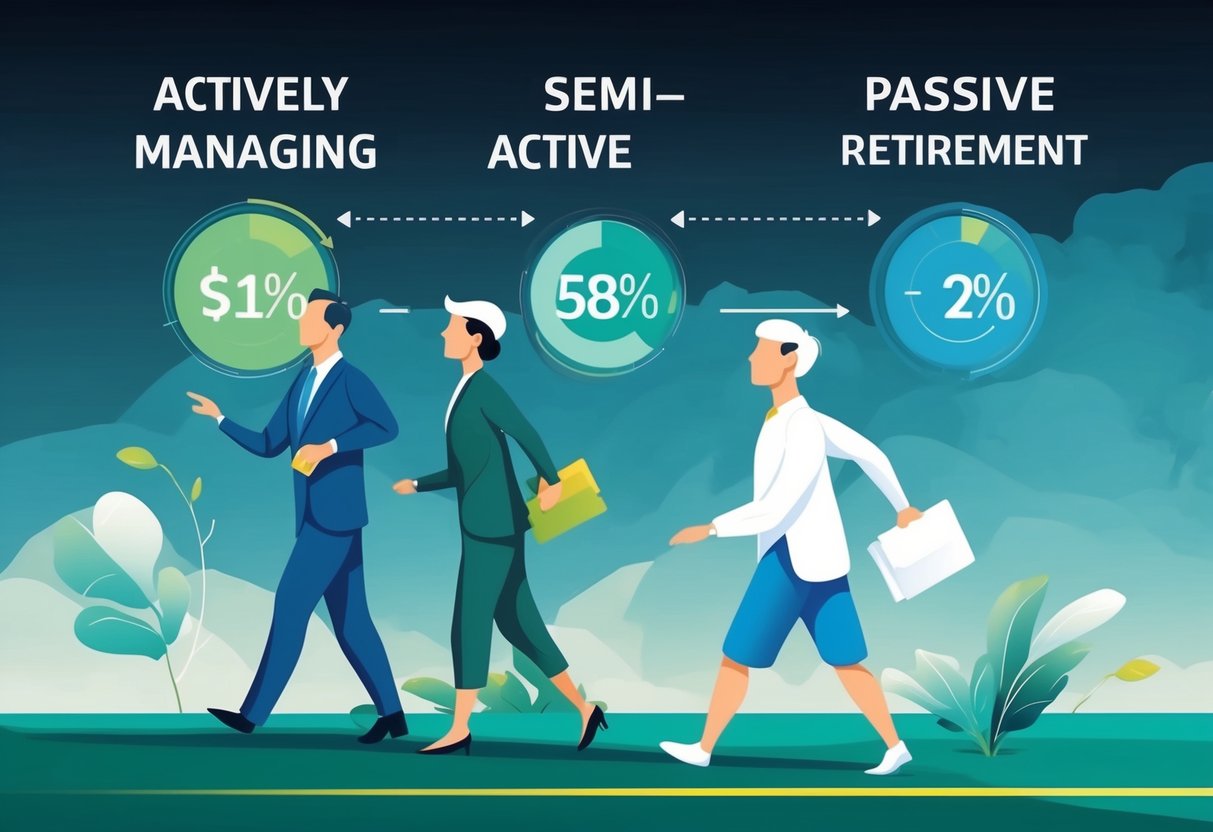
Retirement isn’t just a single moment. It’s a journey filled with changes—some phases are for new adventures, others call for careful tweaks to your spending, habits, and goals.
When I get these shifts, I can make better moves, protect my savings, and actually plan for peace of mind.
What Is the 3-Phase Retirement Model?
The 3-phase retirement model splits retirement into three main stages: the active phase, semi-active (or passive) phase, and the truly passive or supported phase.
In the active phase, I usually have the most energy and freedom. This is when a lot of people travel, start new hobbies, or even pick up part-time work.
The goal here is to enjoy life but still keep an eye on spending.
Then comes the semi-active phase. My pace slows down, but I’m still mostly independent. Maybe I cut back on travel, focus on home routines, or spend more time with family.
Health starts to matter more, and those earlier investments in savings and health plans finally show their worth.
The passive or supported phase means I need more help, either from family or professionals. Medical and living costs usually jump here.
The top priority becomes comfort and security. Learn more about these phases.
Importance of Strategic Retirement Planning
Why does it matter to break retirement into phases? Because each phase needs a different approach to retirement planning.
If I plan ahead, I can move money and resources smoothly between fun, security, and health needs.
Early on, I want to enjoy life but not burn through savings too quickly. Setting a budget and not draining my nest egg right away keeps me from running short later.
As I slow down, I shift toward stability. Healthcare jumps up on my priority list. I might adjust my insurance or even move to a smaller place.
In the last phase, I want my legal documents, care options, and estate plans sorted out. If I skip this prep, I could run out of money fast and leave my family with a headache.
Key Differences Between Each Retirement Phase
Every stage in retirement has its own vibe. The active phase feels like a green light: travel, new experiences, and usually higher spending.
I’m willing to take more risks here, maybe even earn extra through side gigs or property.
In the semi-active phase, things slow down. I spend more time with family and protect what I’ve built. I watch my spending more closely.
Healthcare costs might creep up, but I still have options as long as I stick to a plan.
When I hit the passive phase, life gets simpler and the focus shifts to what I need, not just what I want.
Housing choices can’t wait, and support—whether from family or professionals—matters more than ever. Most of my expenses now go to medical care or adapting my home. Explore more about the retirement phases and what sets them apart.
Phase
Typical Activities
Spending Priority
Main Concern
Active
Travel, Hobbies
Enjoyment, Flexibility
Budgeting Sustainability
Semi-active
Routine, Family
Health, Home
Protection, Routine
Passive
Daily Assistance
Medical, Comfort
Security, Support
Active Phase: Maximizing Growth

In the active phase, my main goal is to grow wealth fast and lay down a solid base for later. I focus on saving as much as possible, picking smart investments, and grabbing every benefit my employer offers.
Contribution Strategies During Active Employment
While I’m working, my biggest advantage is my income. I don’t let money sit around.
I push every dollar to work by making aggressive retirement contributions. Regular 401(k) or IRA deposits really add up.
If I’m over 50, I use catch-up contributions to save even more.
Some companies now match student loan payments with 401(k) contributions, thanks to Secure 2.0. Paying off student loans can actually boost my retirement savings.
I always check if my employer offers this perk. I set my budget so retirement savings come first, and I let my contributions auto-increase with every raise.
Key takeaways:
- Max out 401(k) and IRA when possible
- Use catch-up contributions after 50
- Look for student loan matching if available
Optimizing Asset Allocation for Growth
During the active phase, I don’t let fear run my investment strategy. Growth is the goal, and time is my friend.
I keep most of my money in stocks, not bonds. I lean into broad index funds and target date funds that fit my retirement timeline.
This spreads out risk and lets my money ride the long-term growth of the market.
When markets get rocky, I remind myself not to panic. Rebalancing my asset allocation once a year keeps things on track.
I pay close attention to fees and avoid high-cost funds that eat into my returns.
Sample Asset Allocation Table (age 45-55):
Asset Class
Allocation %
US Stocks
50-60%
International
15-20%
Bonds
15-25%
Alternatives
0-10%
Maximizing Employer-Sponsored Retirement Plans
Employer-sponsored plans like a 401(k) are a no-brainer. I always contribute enough to get the full match—it’s free money.
If my plan has a Roth 401(k) option, I sometimes split my contributions for tax-free growth later.
Some plans offer automatic rebalancing or target date funds, which makes things easier. With Secure 2.0, more features keep popping up, so I check my benefits every year.
If I leave my job, I roll over my 401(k) instead of cashing out, so my money keeps growing. For more on how to win during the active phase, check out this detailed breakdown of retirement phases.
Investment Strategies for the Active Phase

When I started planning for retirement, I realized the early “active” years are a different beast. My strategy aims for long-term growth but keeps risk in check.
Active Investing vs Passive Investing
Should I trust my gut or stick with the market? If I want control and a shot at higher returns, active investing lets me pick stocks or try to time the market.
But honestly, it takes a lot of work and nerves of steel. Most active managers don’t beat the market after fees.
Passive investing is the other side. Index funds or ETFs let me match the market with almost no effort. The fees are lower, so my money grows faster over time.
But there’s no chance at big outperformance—just steady, average returns. Sometimes, I mix both: index funds for the core, then a few hand-picked stocks. Active vs. Passive Life Cycle Savings Strategies dives deeper into this.
Diversification and Risk Management
No single asset class is safe forever. I spread my money across stocks, bonds, real estate, and sometimes private equity.
Diversification helps me avoid losing big if one thing goes wrong.
By starting early, I can weather downturns and let riskier investments recover. Here’s a quick table I use as a reminder:
Asset Class
Key Benefit
Key Risk
Stocks
Strong growth potential
High volatility
Bonds
Steady income, stability
Low growth
Real Estate
Inflation hedge, income
Illiquidity
Private Equity
Unique opportunities
High risk
I check my portfolio every year and rebalance if something’s out of whack.
Role of Stocks and Bonds in Early Retirement
In the active phase, I’ve got time on my side, so stocks shine. Historically, equities bring higher returns than bonds, but there’s more up-and-down.
The younger I am, the easier it is to recover from dips.
Bonds still matter. They cushion the blow during market drops. A 60-80% stock, 20-40% bond split is common for folks in their 40s and 50s.
If I want more growth, I might tilt toward stocks, but not so much that one bad year wrecks my plan.
Using Exchange-Traded Funds (ETFs)
I use ETFs to get broad market exposure at a low cost. They trade like stocks, so I can move fast if I need to.
ETFs cover everything—U.S. stocks, international markets, even bonds. Built-in diversification means I don’t have to pick individual winners.
I always watch the fees, though. Even small expense ratios can eat into gains over time. For more, see Retirement investing: 3 key phases.
Alternative Asset Classes: Real Estate and Private Equity
Why stick to just stocks and bonds? I like to include real estate in my mix, both for steady rental income and as a way to hedge against inflation.
Sometimes I invest directly—buying property myself. Other times, I choose REITs, which basically act like real estate portfolios you can trade on the stock market.
Private equity offers another route. It lets me invest in businesses before they go public. But there’s a catch—these investments usually aren’t very liquid, need more capital, and carry higher risks.
If I pick wisely, though, the payoff can be huge.
I blend these alternatives into my portfolio to boost returns and help smooth out the ups and downs. Still, I never bet more than I can afford to lose. My long-term goals always come first.
Semi-Active Phase: Balancing Growth and Security

As I move into the semi-active phase of retirement, I focus on growing my savings but also keeping my money safe.
Now, I need to balance enjoying life, supporting my family, and protecting myself from the risks that come with aging.
Transitioning Asset Allocations
In this stage, I just don’t have the same appetite for risk as I did in my twenties or thirties.
But putting everything into “safe” assets can be risky too, since I still need some growth. So what’s the right move?
I start shifting my portfolio away from aggressive stocks and lean more on stable choices like high-quality bonds and dividend-paying stocks.
A split like 50% stocks, 40% bonds, and 10% cash works for me, and I adjust as I get older. My 401(k)s and IRAs focus more on security, but I don’t ditch stocks—they’re still essential for long-term growth.
Managing Liquidity Needs
Having cash in the bank just helps me sleep better, especially since emergencies can pop up out of nowhere.
I boost my emergency savings and try to keep at least one or two years of expenses in liquid accounts. Am I ready for a surprise medical bill or helping an adult child?
I avoid locking up too much in illiquid assets or long-term CDs I can’t touch. Flexibility really matters here.
I always keep funds handy in a high-yield savings account, while using retirement accounts for regular distributions. Short-term bond ladders and money market funds give me quick access if I need it.
Protecting Against Inflation
Inflation is sneaky—it eats away at my buying power year after year.
Something that costs $100 now might be $110 before I know it. So, I make sure part of my investments can outpace inflation over time.
I like Treasury Inflation-Protected Securities (TIPS), REITs, and some dividend-paying stocks. These can grow as prices rise.
Letting cash just sit there isn’t enough; even now, I need assets that keep up with costs. This gives my retirement savings more staying power through whatever comes.
Income Generation Strategies
I’m always searching for ways to create a steady stream of cash without burning through my savings too fast.
I mix up my distribution options—combining Social Security, regular withdrawals from retirement accounts, and fixed income from bonds or annuities.
Sometimes I use a systematic withdrawal plan, like taking out 4% a year and adjusting as needed. I pay close attention to taxes and required minimum distributions.
I set up different buckets for income—Social Security, pensions, investments—so I’m not leaning too hard on any single source. That’s how I keep things under control in these semi-active years, no matter what life throws at me.
Passive Phase: Preserving Wealth and Distributions

In the passive phase, I focus on managing distributions, maximizing income security, and keeping taxes as low as possible.
This stage takes careful planning—especially with retirement accounts, Social Security, and required minimum distributions.
Withdrawal Strategies and Tax Efficiency
The timing and order of my withdrawals can make the difference between my nest egg lasting or drying up.
It’s not just about taking money out—I want to cut taxes and make my dollars stretch.
First, I look at which accounts offer tax advantages. Traditional IRAs and 401(k)s are tax-deferred, while Roth accounts let me take money out tax-free if I follow the rules.
My usual move: I tap taxable brokerage accounts first, then tax-deferred accounts, and save Roth IRAs for last. Why? This can help me control my taxable income and delay big required distributions.
I hate surprises from the IRS, so I think about Roth conversions in low-income years and avoid giant withdrawals that might bump me into a higher tax bracket.
Working with a financial planner helps me set up a withdrawal schedule that squeezes out every tax break I can get.
Social Security Optimization
Social Security isn’t just a monthly deposit—it’s a big decision that can affect my finances for decades.
When I claim Social Security really matters. If I claim early at 62, my monthly payments are lower for life. If I wait until my full retirement age (66 or 67), I get the full benefit.
Each year I delay past full retirement age, my benefit grows by about 8% until age 70. Not everyone realizes how powerful that is, especially if I’m healthy or have a spouse who could get survivor benefits.
I consider whether my spouse worked, and what their benefit looks like. Coordinating spousal benefits and timing can mean a bigger combined income.
Making the right choice here can mean the difference between scraping by and having some breathing room. For more on retirement’s phases, I like this guide to the three key phases of retirement investing.
Required Minimum Distributions
Required Minimum Distributions (RMDs) aren’t optional. When I hit the age set by the IRS—currently 73 for most people—I have to start taking minimum withdrawals from traditional IRAs, 401(k)s, and similar accounts.
If I skip them, the penalties are brutal—sometimes up to 25% of what I should’ve withdrawn. That’s a headache I don’t need.
The IRS uses my account balance and life expectancy tables to calculate my withdrawal amount. Each year, I might have to take out more, which can push me into a higher tax bracket.
I plan ahead by estimating my future RMDs and, if I need to, I work with my advisor to avoid surprise tax bills. Roth IRAs don’t have RMDs while I’m alive, so I get more control and flexibility.
I also look at charitable giving, like Qualified Charitable Distributions (QCDs). I can send some or all of my RMDs straight from my IRA to a charity, and that amount won’t count as taxable income. That’s a win-win if I want to give back and trim my tax bill.
Securing Lifetime Income
Retirement should bring freedom, not fear. But honestly, who doesn’t worry about running out of money in their eighties or nineties?
That’s where securing lifetime income comes in.
Some folks use annuities to turn a lump sum into a steady paycheck that lasts for life. Not all annuities are created equal, though. I look for transparent products with stable payouts and reasonable fees.
Pension plans, if I have one, work the same way—they can provide lifelong income with minimal effort.
I keep my portfolio diversified. Some bonds, real estate, or dividend-paying stocks add a layer of steady income. But I stay cautious—not every income stream is as safe as it looks, and risk management matters more than ever.
I balance guaranteed sources—like Social Security, pensions, and annuities—with withdrawals from my investments. That way, even if the market takes a dive, I still have reliable income for my basics.
For a deeper look at how income and wealth shift over time, I recommend checking out this overview of the 3 phases of retirement.
Retirement Plan Governance and Compliance
Clear, effective retirement plan governance helps me feel confident my money’s protected.
The right plan guards my interests, keeps me compliant, and gives me flexibility as I move through every stage of retirement.
Fiduciary Responsibilities in Retirement Planning
When I think about retirement plans, I always ask: who’s really looking out for my nest egg?
Fiduciary duties require someone—maybe my employer or a committee—to act only in my best interest. If they cut corners or ignore plan investments, I’m the one who gets burned.
Good fiduciaries check everything. They review fees, performance, and service quality. They avoid self-dealing and conflicts of interest.
If a fund isn’t performing or has high expenses, they have to replace it. For those of us who want control, it’s good to know that fiduciary responsibilities are legally required—not just a suggestion.
ERISA and Regulatory Standards
Ever heard of ERISA? It’s not just another government acronym.
The Employee Retirement Income Security Act of 1974 (ERISA) sets rules that protect people like me when our money’s in a retirement plan. Some of these rules feel strict, but I get why they’re there.
Under ERISA, plans must give participants clear info. That means I get disclosures about fees, investment choices, and my rights.
If the plan doesn’t comply, there are hefty penalties. The law also sets minimum standards for tracking and vesting my benefits.
ERISA covers more than just eligibility and info—it has requirements for funding, claims, and appeals too. Navigating all this can get confusing, but these rules help make sure I’m not left in the dark about my future.
Impact of Tax Reform
Every few years, Congress changes the tax code. Ever wonder what tax reform really means for retirement?
Some changes close loopholes or cap how much I can save in tax-advantaged accounts. Others open new doors, like Roth options or bigger catch-up contributions.
Lately, Congress has lowered tax rates on retirement withdrawals but limited up-front deductions. That changes how I pick investments and plan withdrawals.
A wrong move could cost me thousands, but a smart one means more for retirement or my kid’s education.
It’s not enough to just “save.” I have to strategize, because tax reform can take a real bite out of my long-term wealth if I’m not careful.
I follow the debates and talk to professionals, since today’s tax break could be tomorrow’s tax trap.
Role of Professional Management
Managing a retirement plan isn’t simple. Can I really handle it all myself and keep up with all the changes in laws, investments, and the market? Maybe, but honestly, professional managers bring something different to the table.
They mix legal knowledge, investment experience, and compliance skills in a way that’s tough to replicate on your own. The best of them hunt for cost-efficient investments, whether they’re active or passive.
This isn’t just for giant company pensions anymore. More plans—including pooled employer plans—let regular folks like me tap into professional management suited for a group. I get access to institutional-level strategies without pretending to be an expert in everything.
When professionals run the show, they keep things updated, handle audits, and make sure ERISA rules stay on the radar. Personally, I’d rather enjoy my free time than stress over paperwork or the latest regulation. Sometimes, hiring help just means I can actually sleep at night.
Special Considerations and Advanced Planning

Smart retirement planning isn’t only about saving more. It’s about using the right systems and taking advantage of every plan you can, weaving everything together so your future isn’t left to chance.
Teachers Retirement System and Public Sector Plans
If you’re in a Teachers Retirement System or work in the public sector, you probably have access to pension-based benefits. These plans work differently from private 401(k)s and usually provide defined monthly payments when you retire.
Have you checked your payout options? Choosing between a lump sum and monthly income could shape your finances for years.
Pension formulas can get confusing. They often depend on years of service, final salary, and a pension multiplier. I always run the numbers twice—once with the standard formula, and again with early retirement reductions or survivor options.
I’ve watched colleagues get surprised by how small changes in years worked or salary can swing the payout. If you haven’t requested a detailed pension estimate lately, it’s probably time. Head over to the plan’s portal or call the benefits office to check for updates.
You should double-check your beneficiary choices and make sure you know how cost-of-living adjustments (COLA) work. COLAs can help protect your income down the road. For more details, planning for the three stages of retirement covers key financial points for public sector plans.
Deferred Compensation Plan Options
Ever feel like your retirement catch-up options are just not enough? That’s where deferred compensation plans, like 457(b)s, can really make a difference.
These plans are built for government employees, teachers, and some nonprofit workers. Unlike a 401(k), a 457(b) lets you save pre-tax dollars and skip early withdrawal penalties if you leave your job after age 55.
Should you focus on the deferred comp plan after maxing out your 403(b) or 401(k)? I’ve seen some sharp planners use both. The trick is knowing the contribution limits, which can be way higher as you near retirement—sometimes double under the catch-up rule.
I pay close attention to the investment options, since these plan menus can feel more limited than private plans. Before diving in, always compare fees, withdrawal rules, and required minimum distribution (RMD) schedules.
When you use a deferred compensation plan wisely, you can boost your savings and gain extra flexibility. See how other semi-retirement savers use these options to get ahead.
Integrating Multiple Retirement Accounts
Juggling a bunch of retirement accounts—like a 401(k), IRA, 403(b), and a pension—can feel overwhelming at first. But honestly, if you want real control, you’ve gotta keep tabs on everything.
Ever sat down and mapped out your withdrawal plan? The way you handle taxes and the order you pull money out could save—or cost—you thousands.
I usually start by jotting down my accounts in a table:
Account Type
Tax Advantage
Owner
Current Value
Withdrawal Rule
Pension
Pre-tax
Me
$XXX,XXX
Annuity/Payout Options
401(k)
Pre-tax/Roth
Me
$XXX,XXX
Age 59½/Required Minimums
IRA
Pre-tax/Roth
Spouse
$XXX,XXX
Age 59½/Required Minimums
457(b)
Pre-tax
Me
$XXX,XXX
No Penalty If Separated
Laying it all out like this always gives me a clearer picture. I can spot what’s missing, or what just isn’t working.
Sometimes I wonder—should I roll those old 401(k)s into an IRA? It might give me more investment options and make things less of a headache.
And then there’s the big question: which account do I touch first? Roth IRA, pension, or maybe my taxable brokerage?
I also check how I’ve invested in each account, making sure my overall plan still matches my comfort with risk.
When I pull all my accounts together, I can actually manage taxes better, plan for healthcare, and even make estate planning less stressful.
Plus, it just keeps cash flow a lot smoother, no matter what stage of retirement I’m in.
If you’re scratching your head over all this, this planning guide lays out how to stack up different income sources for each chapter of retirement.