
Ever wanted to just hit pause on your work routine and take a real break—months, maybe even a year or two—while you’re still in your prime earning years? Designing a mini-retirement in your 40s or 50s is way more possible than most folks realize, and you don’t need a lottery ticket or to abandon your long-term plans. If you know how to plan, you can step away and keep your financial security intact.

We all hear the usual advice: grind until 65. But is that honestly the only option? With some smart planning, you can make space for new experiences, reconnect with family, and take care of your mental health—without wrecking your career or money goals.
A mini-retirement isn’t some wild leap. It’s about taking control, building in flexibility, and letting your work support your life now, not just “someday.”
Key Takeaways
- You can plan a mini-retirement with the right financial and career moves.
- Building up savings and backup plans really matters.
- Life during your break can be richer and safer with thoughtful risk management.
Understanding Mini-Retirement

People in their 40s and 50s are beginning to rethink work and money. The idea of a real break—longer than a vacation but not forever—suddenly seems both practical and pretty appealing.
What Is a Mini-Retirement?
A mini-retirement happens when I step away from my regular job for months or even a year. Unlike a quick vacation, this is a deliberate pause from my usual life.
I might spend it traveling, learning something new, or just focusing on family.
I’m not quitting forever. I’m taking a break to recharge and come back with new energy.
Many people use a mini-retirement to chase a dream or recover from burnout. It’s about living more fully now, not just waiting for retirement.
Mini-retirements aren’t just vacations. I actually leave my job or business for a good chunk of time, giving myself room to grow.
Some folks start with a “micro-retirement,” which is a shorter break to see if it fits before going bigger.
Key Differences Between Mini-Retirement, Sabbatical, and Career Break
People mix up mini-retirements, sabbaticals, and career breaks all the time, but they’re not the same.
- Mini-retirement: I set it up and pay for it myself. It’s a personal choice to pause work and live better now.
- Sabbatical: Usually, my employer gives me official leave, sometimes paid, often for study or research. It’s more formal.
- Career break: I might leave the workforce for family, health, or personal stuff. This isn’t usually about personal growth or adventure.
Here’s a quick side-by-side:
Type
Who Initiates?
Duration
Purpose
Mini-retirement
Individual
Months–1 year
Personal growth
Sabbatical
Employer/Worker
Weeks–1 year
Study/Research
Career Break
Worker
Varies
Family/Health
All three have their place, but a mini-retirement gives me the most freedom to shape my life.
Trends Among Gen Z and Other Age Groups
Gen Z is already trying out micro-retirement ideas when they can. They seem to value free time and flexibility, sometimes more than a fat paycheck.
Why does that matter for me in my 40s or 50s?
Gen Z’s attitude is shifting how workplaces see career breaks. Employers are starting to notice that longer breaks—even for personal reasons—can create happier, more loyal workers.
My generation usually picked one path and stuck with it for decades. But now, watching younger people mix work and rest, I see that a well-timed break isn’t reckless. It can actually pay off.
I don’t need to wait until my 60s to enjoy a taste of “retirement.” If Gen Z can pull it off, why not me?
Assessing Your Financial Foundation

Designing a mini-retirement in your 40s or 50s takes more than just wishful thinking. I need a real look at my finances—what I own, what I owe, and what I’ve actually saved for later.
Calculating Net Worth and Retirement Savings
I start with a simple question: how much am I really worth, dollar for dollar?
To figure out net worth, I add up my home’s value, retirement accounts, investments, savings, and other assets.
Then I subtract every debt—mortgage, car loans, credit cards, you name it.
Here’s the breakdown I use:
Assets
Amount
Home
$X
401(k)/IRA
$X
Savings
$X
Investments
$X
Other Assets
$X
Liabilities
Amount
Mortgage
$X
Car Loans
$X
Credit Cards
$X
Other Debts
$X
Net Worth = Total Assets – Total Liabilities
But net worth is just the start. I look closer at my retirement savings and ask, is it enough for time away from work?
If I’m planning a mini-retirement, I estimate what I’ll need—not just for basics, but for healthcare, kids’ stuff, and emergencies.
I check my monthly spending and multiply by the number of months I want off, then add a cushion.
If the numbers don’t work, I know I need to adjust my plans or save more.
Addressing Debt and Credit Card Debt
Debt can sneak up on you. Credit card balances grow, but your options shrink fast.
Before any mini-retirement, I get honest about what I owe.
High-interest debt, especially credit cards, eats into savings faster than you’d think.
I gather all my statements and list out:
- Outstanding balances
- Minimum payments
- Interest rates
My first step is to attack anything with double-digit interest, because that stuff destroys wealth.
If I can’t wipe out debt fast, I set up a tough payment plan or look for better options, like a balance transfer or a lower-rate loan.
Every dollar I pay now is one less thing to stress about during my break.
Taking control of debt isn’t just a math thing—it’s about owning my future.
If you want more on managing debt for retirement, check out this guide to setting retirement goals.
Building a Mini-Retirement Savings Plan
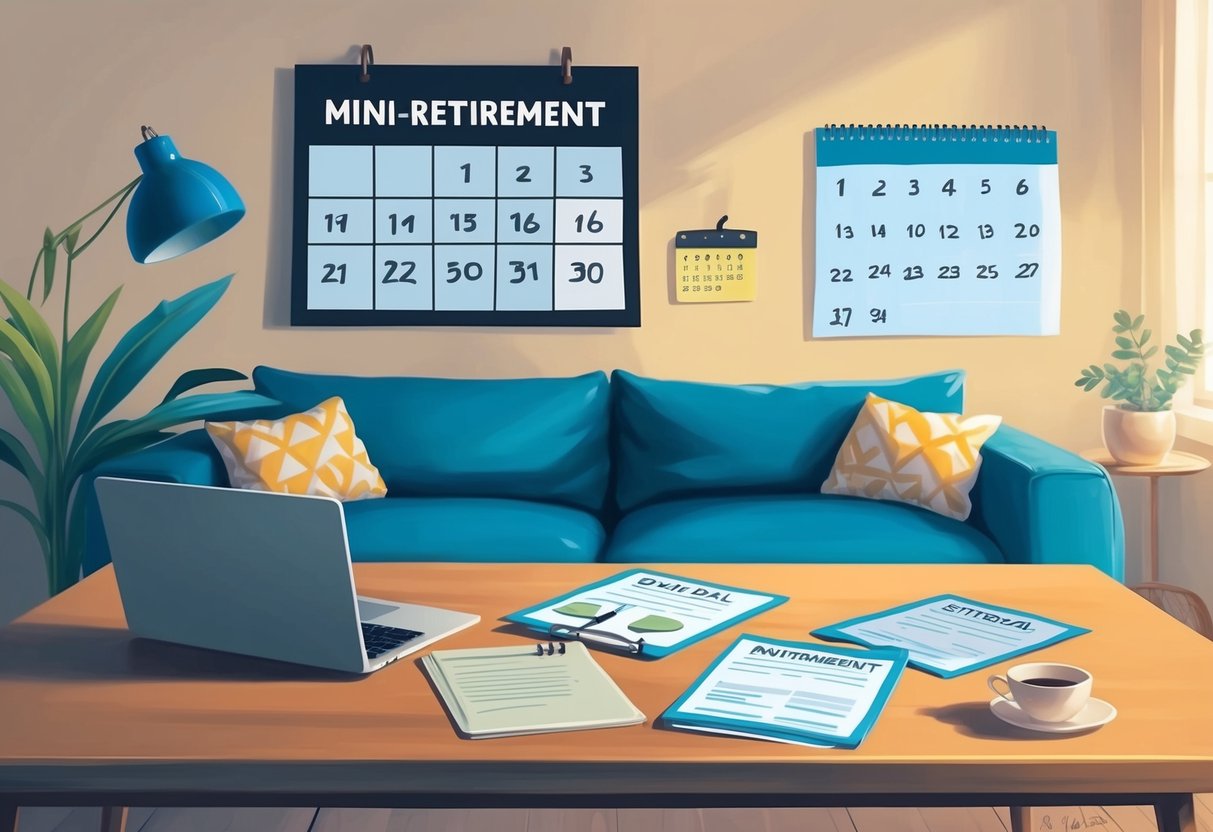
A smart savings plan is the backbone of a real mini-retirement.
I focus on building a cushion for the main expenses, seeing how my choices impact long-term retirement, and setting up simple strategies to keep my savings on track.
Setting Financial Goals for Time Off
First, I ask, “How much do I need for my time off?” That answer shapes everything.
For a six-month mini-retirement, I add up my monthly expenses—housing, healthcare, food, debt, and family stuff.
I throw in a buffer for emergencies and surprises.
Here’s my list:
- Core monthly expenses (rent, mortgage, groceries)
- Health insurance premiums
- Extras: travel, hobbies, family outings
- Debt payments
- Emergency fund (3-6 months is my usual target)
Next, I compare this total to my current savings.
If there’s a gap, I break it down. Can I save more before leaving work? Cut expenses? Pick up a side gig? Planning ahead makes the difference between just dreaming and actually doing it.
Maximizing 401(k) and Social Security Considerations
I do my best not to touch my 401(k) or retirement savings, unless I have no other choice. Early withdrawals come with penalties and taxes, and every dollar I pull out now is one less for my future.
To protect my long-term plans, I look at ways to keep my 401(k) investments growing.
If my job allows, I try to max out contributions before my mini-retirement starts.
I always check the rules—am I vested, or will leaving early mess with my company match?
With Social Security, I know that taking time off can lower my future monthly benefit since it’s based on my best earning years.
I use the Social Security Administration’s calculators to see how it shakes out. This step is too important to skip.
Automating and Diversifying Savings Strategies
I set up automatic transfers so money moves from my paycheck—or checking account—straight into my mini-retirement fund each month.
The less I have to think about it, the more likely the savings actually build up.
But I don’t keep all my cash in one place. I use a mix of high-yield savings, short-term CDs, and maybe a brokerage account for some extra growth if I have a few years to plan.
These accounts give me flexibility when I need it.
Setting savings on autopilot frees up my brain for bigger stuff.
I track everything with a simple spreadsheet or app to see progress. Staying consistent is my secret weapon for making a real break from work possible.
Planning Your Career and Employment Options

Taking a mini-retirement in your 40s or 50s means thinking beyond just your money. I need a plan for how the break fits into my work life and what kind of leave I can actually get from my employer.
Timing Your Mini-Retirement within Your Career
When I think about a career break or sabbatical, timing feels like everything. I take a close look at where I am in my job path. Am I at a stage where my skills are in demand? Or maybe my industry’s slowing down? Picking the right moment can protect my career progress and make coming back a lot smoother.
Sometimes, big projects or key milestones at work give me a natural pause point. I ask myself: Will stepping away now hurt my long-term prospects, or will it help me return recharged? If I’ve built a solid track record and good relationships with managers, I can step away without burning bridges.
I know gaps in employment might raise questions later. So I get ready to share how the mini-retirement helped me grow or pick up new skills. Taking this break during a stable phase in my career can help cut down on risk and uncertainty.
If I want to see how others have taken mini-retirements, there are plenty of stories out there.
Negotiating a Sabbatical or Leave of Absence
I never just assume my employer has a clear sabbatical policy. I dig into employee handbooks and chat privately with coworkers who’ve taken extended leave. Sometimes, people use unpaid leave, short-term disability, or even paid time off in surprising ways.
Preparation matters. Before I ask, I jot down exactly what I want: how long I’ll be gone, how my work will get covered, and how I can help make things seamless. I highlight the benefits to the company, too—a recharged employee can do better work. If I pitch it right, a leave of absence can work for everyone.
Tips for negotiation:
- Book a private meeting with my manager.
- Clearly explain my plan and reasons—maybe to recharge and avoid burnout.
- Offer coverage solutions and stay flexible on timing.
- Be ready to talk about rehiring, benefits, and what if the answer’s a no.
If I want more info on how mini-retirements fit into work life, including risks and benefits, I check out this employment options for mini-retirement overview.
Designing Life During Your Mini-Retirement

A mini-retirement isn’t just time off. It’s a shot to rebuild my daily life, grow personally, and finally try new experiences I’ve put off for ages. I want this time to matter, not just drift by.
Structuring Daily Life for Personal Growth
When I step away from work, my days can feel a bit empty at first. That’s why I set up a loose schedule. I split my time between learning, health, and relationships. Maybe I’ll save mornings for exercise or reading, and afternoons for creative projects or volunteering.
Daily rituals keep me steady. I might journal at breakfast, take a walk mid-morning, or spend an hour learning something new—cooking, photography, a language, whatever sparks interest. I make space for family, too. Even a board game with my kids or a walk with my partner can mean a lot.
What should I really focus on? I jot down top priorities and block out time for each. Mini-retirement gives me freedom, but honestly, a little structure helps me get more out of it. This is the moment to invest in myself, not just veg out.
Travel and Experience Prioritization
If I want to travel, planning ahead makes a difference. Do I want a long adventure, a few short trips, or some mix? I dig into destinations, check costs, and plan trips for my most flexible windows. Traveling off-season can save money and headaches.
But travel isn’t only about ticking off places. I ask myself, “What do I really want to experience?” Maybe I dream of living abroad for a month, tasting new foods, or meeting locals. Instead of rushing around, I try to go deeper—like joining a cooking class, volunteering, or just taking the bus with everyone else.
Here’s how I plan:
- List must-see places or must-do activities
- Set a realistic budget
- Pick experiences that fit my interests
- Stay flexible—sometimes, the best stuff happens by accident
By making lists and budgeting, I can turn my mini-retirement into something way more than just a break.
Minimizing Risks and Planning for the Unexpected

Taking a mini-retirement in your 40s or 50s isn’t just about escaping work. It’s about protecting what you’ve built and making sure you don’t put your future at risk.
To do it right, I have to pay attention to healthcare, insurance, and how my break could affect long-term financial freedom.
Healthcare and Insurance Considerations
The cost of healthcare can mess up a budget fast if I’m not careful. Employer health insurance usually disappears during a mini-retirement. I need a plan to fill that gap, or I could face huge bills if something happens.
Here’s what I look at:
- Buy a private health plan through the ACA or state exchanges.
- Use COBRA to stretch my current coverage, even if it costs more.
- Try short-term health plans for basic coverage, but I know they can be pretty limited.
If my spouse has a job, I might switch to their plan and save some money. I also check out accident and critical illness policies just in case, since hospital bills can drain savings quickly.
For prescriptions and doctor visits, I always compare prices and get estimates before picking new coverage. Spending a few hours researching now can save me thousands down the road and give me some peace of mind.
Protecting Long-Term Financial Security
Jumping into a mini-retirement without a safety net? That could seriously mess with my future financial freedom. I really need a plan for regular expenses, unexpected costs, and making sure my savings don’t just sit there.
First off, I keep an emergency fund that covers at least 6-12 months of expenses. If I’ve got debt, I make a plan to knock out high-interest balances before I step away from work.
My mini-retirement budget has to cover living costs, insurance, plus a little extra for those inevitable surprises. I also look at how this break will affect my retirement accounts.
Will I hit pause on contributions? If I do, what’s that mean for long-term growth? Usually, I set up automatic investments to keep going—even if it’s just a smaller amount—so my money keeps compounding.
Here’s a simple checklist I use to keep things sharp:
Risk
Action
Income loss
Build a bigger cash buffer
Market drop
Keep investments diversified
Unexpected bills
Keep credit options open
People I know who’ve taken mini-retirements say it’s smart to have a “return to work” plan, just in case. I try to keep my professional network active and my resume fresh.
By planning for what might go sideways, I give myself a better shot at enjoying time off while protecting my path to true financial security.