
In today’s world, relying solely on employer pensions for a secure retirement feels more like a distant memory than a realistic strategy.
Have you ever wondered why so many employers have moved away from offering traditional pension plans?
Fewer employers are offering traditional pension plans, leaving many workers to navigate retirement savings on their own. With changes in employer contributions and the rise of 401(k) plans, the landscape of retirement planning has shifted significantly.

The numbers tell a compelling story. Less than 15% of private industry workers had access to a pension in 2022. That’s a stark contrast to the past when pensions were the norm rather than the exception.
Are we facing a future where employer pensions become completely obsolete? It’s a question worth considering as we plan for our financial futures.
A new generation of workers is now transitioning to retirement relying more on personal savings and government programs like Social Security.
The financial burden is shifting away from employers and landing firmly on individuals. How does this affect your plans for the future? The shift in responsibility brings about both challenges and opportunities, demanding a strategic and informed approach to personal finance.
Key Takeaways
- Employer pensions are becoming rare.
- Retirement planning now requires personal savings.
- Social Security plays a growing role.
Historical Context of Employer Pensions

Employer pensions have shaped retirement planning for generations. Understanding their evolution helps clarify how we arrived at today’s options like defined benefit and defined contribution plans.
Let’s explore these models and significant changes that have influenced pensions over the years.
Defined Benefit vs. Defined Contribution
In the realm of retirement, defined benefit plans once dominated. These plans promised a fixed payout upon retirement, based on salary and years of service. Imagine the security of knowing exactly how much you’d receive each month. Isn’t that comforting?
Yet, this security came with a hefty price for companies, who bore the investment risk.
With the rise of defined contribution plans, the game changed. Employers shifted the risk to employees. In these plans, contributions are fixed, but retirement payouts vary based on investment performance. It’s like investing in a mutual fund without guaranteed returns. Does this flexibility suit everyone’s needs? It certainly offers more freedom but at the cost of certainty.
Evolution of Pension Plans
The journey of pension plans began centuries ago, with early models in places like pre-industrial Europe. Large employers became the cornerstone of pension systems in industrial economies.
Over the years, the motives behind offering pensions evolved. Initially, they aimed to support workers financially as they aged.
As businesses grew, the need to attract and retain talented workers pushed them to offer appealing retirement options. During the 20th century, pensions transformed from simple acts of goodwill to essential benefits. This historical evolution reveals why some people still consider employer pensions critical for retirement.
Regulatory Landscape and Pension Reform
Navigating the complex maze of pension regulations can feel daunting. In the past, few rules governed these plans, allowing companies to manage them much like they pleased.
Over time, as stories of mismanagement emerged, governments began stepping in, ushering in reforms to protect employees.
Pension reform has often been a balancing act between ensuring solvency and providing fair benefits. Laws such as the Employee Retirement Income Security Act (ERISA) in the U.S. standardized rules and increased transparency. But have they done enough to secure retirement for everyone? Reform efforts continue, evolving with economic conditions, ensuring pensions remain a viable source of retirement income for future generations.
Current State of Employer-Sponsored Retirement Plans
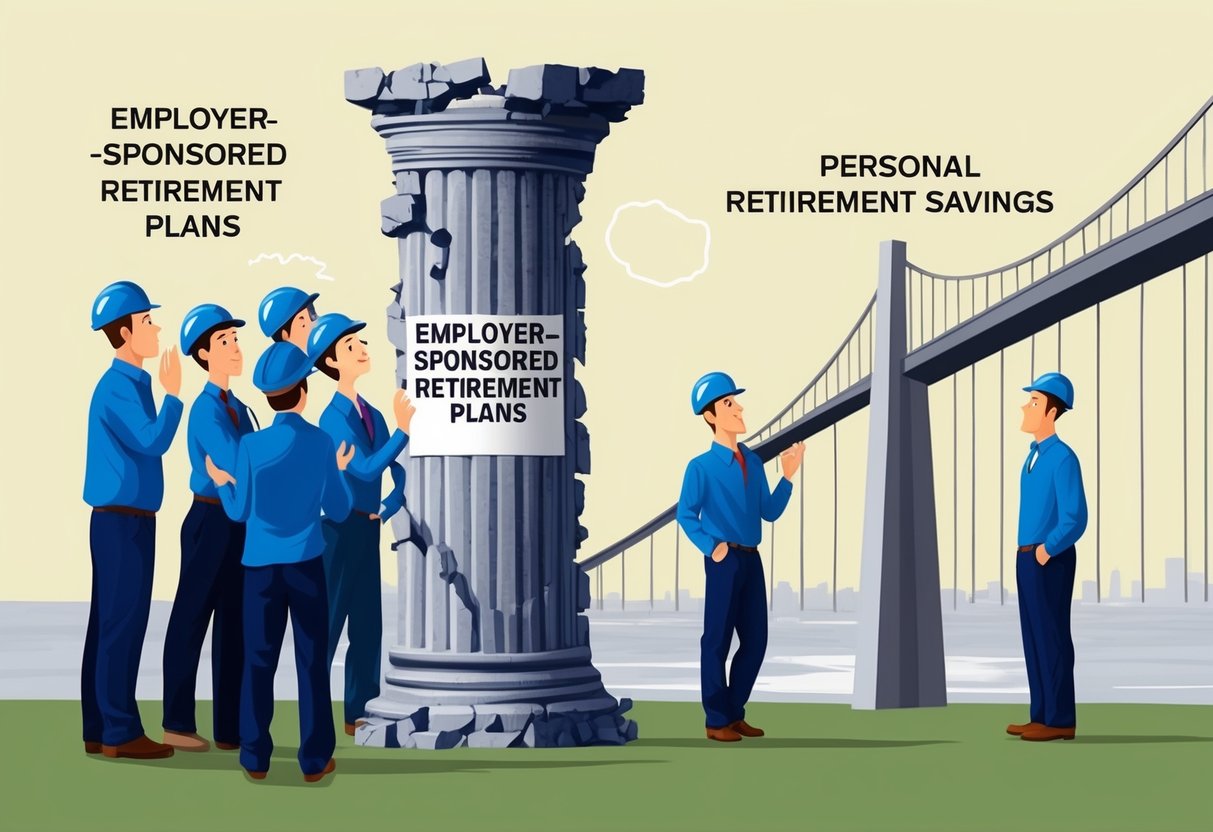
In the modern world, employer-sponsored retirement plans have undergone significant changes. The shift from traditional pension plans to 401(k)s and similar accounts has created new challenges and opportunities.
These changes raise questions about financial security and retirement readiness.
Popularity of 401(k)s and Linked Accounts
401(k) plans have become the main choice for many employees seeking retirement security. Why have these plans gained such popularity? They offer tax advantages and the flexibility to control investments.
Employees can contribute a portion of their paycheck, often with employer matching, to build a retirement nest egg.
Yet, the reliance on 401(k)s places the burden on individuals to make smart investment choices. Without careful planning, these accounts can fall short of expectations.
It’s crucial to consider management fees and potential risks involved. While they have replaced traditional pensions, are they truly enough for a comfortable retirement?
Influence of the Financial Accounts of the United States
The financial backdrop in the United States plays a big role in retirement planning. Interest rates, market performance, and inflation impact how retirement plans function.
Changes in the economy can shift the value and growth of retirement accounts, affecting future solvency.
The transition from pensions to accounts like the 401(k) also reflects economic shifts. As companies minimize liabilities, employees bear more responsibility. How do economic conditions influence retirement security? Understanding these dynamics can make a world of difference when planning for retirement success.
Issues Affecting Retirement Plan Coverage
Coverage gaps still exist in employer-sponsored retirement plans. Many workers lack access to retirement savings options.
State initiatives are trying to fill these gaps, like Virginia’s RetirePath, which mandates coverage for certain employers (check more details on state initiatives).
Why do these gaps persist? Employer size and industry can influence plan availability, with smaller businesses often unable to provide comprehensive plans. Additionally, there are disparities based on geography and demographics (learn more about these disparities in a detailed study).
Understanding these issues can help us advocate for better solutions and ensure robust retirement readiness.
Risks and Uncertainties
Navigating employer pensions today requires careful thought. Various factors threaten their reliability, impacting how we plan for retirement.
Dependence on Employer Solvency
Are you confident your employer will remain financially strong? Employer-sponsored retirement plans hinge on the company’s ability to fulfill its promises.
If an employer faces bankruptcy, pensions may be at risk. Even with safety nets like the Pension Benefit Guaranty Corp, benefits might be reduced.
The health of your pension often reflects your employer’s financial state. Keeping an eye on your company’s financial health can be as essential as monitoring your own investments. What happens if the company you depend on can’t deliver?
Impact of Market Volatility
How steady are your pension’s investments? Market ups and downs can turn a reliable pension plan into a questionable one.
As markets fluctuate, so does the value of pension assets. Economic downturns or financial crises can dramatically affect the funds set aside for retirement.
It’s not about timing the market but understanding its influence on your future benefits. Building a diversified investment portfolio can offer some cushion, but the reliance on employer-directed investments leaves little room for personal control. Are you ready to ride the waves of market changes?
Regulatory and Legislative Changes
Ever wonder how laws on pensions can shift? Regulations on pensions don’t remain constant.
Changes in laws can alter retirement age, funding requirements, or tax implications. Such shifts often respond to broader economic trends or fiscal policies.
Staying informed about legislative changes helps anticipate adjustments in benefits or contributions. It’s essential to understand how these laws might favor one type of retirement plan over another. After all, what seems stable today might change tomorrow. How prepared are you for legislative shifts that could impact your retirement finances?
Retirement Income and Social Security Interaction

When planning for retirement, understanding how Social Security interacts with other income sources like pensions is crucial. Balancing these components can determine the retirement lifestyle you will enjoy.
Supplementing Social Security with Pensions
Social Security benefits are designed to replace only a portion of your pre-retirement income. Did you know that relying solely on these benefits might not be enough? That’s where employer pensions come into play.
Employer pensions can supplement Social Security, offering a more comprehensive financial safety net during retirement.
With longer lifespans and rising living costs, having multiple income sources can ease financial stress. A pension can fill the gap that Social Security leaves, providing a stable and predictable income stream. Investing in a pension can help ensure that you don’t have to drastically change your lifestyle once you retire.
Concerns About Social Security Solvency
Are you worried about the longevity of your Social Security benefits? It’s a concern shared by many.
While Social Security has been a reliable source of income for decades, there are ongoing concerns about its future solvency.
With an aging population and fewer workers supporting retirees, the program’s long-term sustainability is under scrutiny. These issues could impact future payout levels and eligibility requirements. It prompts many to consider additional savings and investments.
By understanding the potential challenges to these benefits, you can make more informed decisions about your retirement plan, possibly looking into pensions or other savings strategies to secure your financial future.
Socioeconomic Impacts

Isn’t it interesting how employer pensions shape our financial landscape? These pensions affect various aspects of our lives, including wealth distribution and retirement planning.
Wealth Inequality and Retirement Assets
Employer pensions have been a vital part of retirement portfolios for many families. Yet, as traditional pensions shift to defined contribution plans, I see them playing a significant role in wealth inequality.
While defined benefit plans offered a predictable income after retirement, the growing focus on defined contribution plans means that individuals must actively manage their retirement assets.
This increase in self-managed plans can lead to disparities. Why? Because financial literacy and access to investment advice are unevenly distributed. This change affects how different socioeconomic groups accumulate wealth over time.
Disparities in Wealth Quartiles
When we look at wealth quartiles, the impact of pension disparities becomes even clearer. For lower and middle quartiles, employer-sponsored retirement plans used to provide a reliable safety net. Now, this safety net is disappearing faster for these groups.
The switch from defined benefit to defined contribution plans has widened the gap between these quartiles and the wealthiest segment.
Data shows a decrease in total employer-sponsored retirement plan coverage among lower wealth groups. What’s the significance of this trend? It implies that those in lower quartiles now face more financial insecurity.
Wealthier quartiles, in contrast, have the means to diversify their assets beyond employer pensions, creating a financial cushion that others lack.
Personal Finance Considerations
Navigating the complexities of employer pensions requires attention to several critical areas to ensure a secure financial future.
I find it essential to maximize benefits, plan for a steady income stream, and make strategic contributions.
Maximizing Employer Pension Benefits
To get the most from employer pension plans, it’s crucial to understand the specific benefits offered.
Many employers give matching contributions. Do I contribute enough to get the full match? This is often a no-brainer because it’s essentially free money.
Knowing the vesting schedule is another significant factor, as this determines how long I must work to gain full ownership of employer contributions.
By staying informed, I can make decisions that align with my retirement goals. Open communication with the HR department can also clarify any doubts and ensure I leverage all available opportunities.
Planning for an Income Stream in Retirement
A smooth transition into retirement isn’t just a dream—it’s achievable with proper planning.
First, estimating how much income I will need is necessary. Pension plans often cover only part of what I had earned. This shortfall requires careful planning to maintain my desired lifestyle.
I explore additional income sources, such as personal savings, investments, or a 401(k), to supplement my pension.
Diversifying my income streams provides more security, helping me to weather economic changes. It’s about creating a retirement plan that aligns with both my needs and aspirations.
Employee Contributions and Savings Strategies
Deciding how much to contribute toward retirement savings can be tricky.
I aim for a percentage of my income that feels sustainable. Consistent contributions are key. This can even start from 10% to 15% of my annual income.
Matching this with a budgeting strategy that reduces unnecessary expenses will enhance my savings capability.
I prioritize financial goals and find opportunities to save without compromising my present lifestyle’s quality. Effective savings strategies form a solid foundation for a comfortable retirement, freeing me from constant money worries.
Looking Towards the Future

I see several challenges and opportunities unfolding in the realm of employer pensions. These will impact not only how we think about retirement but also the overall economic landscape.
Demographic Shifts and Retirement
As I look at the changing demographics, I see a growing number of older workers. This shift puts pressure on retirement systems, including Social Security.
Fewer working-age individuals relative to retirees mean more strain on public resources. Will traditional pensions keep pace with this trend? It’s a critical question.
Some of us may find that relying solely on employer pensions is risky. The need for diversified retirement plans is greater than ever. We must think about how to secure our future with multiple income streams.
Potential for Wealth Concentration
With decreasing pensions, wealth concentration is likely to increase. Those without diverse investments might find their financial security threatened.
What does this mean for us? It means the rich could get richer while others may struggle to maintain a stable financial footing.
Investing wisely and considering various asset types can help reduce this gap. Relying on employer pensions alone might not offer the security one once expected. I encourage you to evaluate how your retirement strategy could adapt in this landscape.
Families Close to Retirement Concerns
For families near retirement, the diminishing role of employer pensions can be unsettling. You might wonder, “Will my savings last?”
The truth is, the lack of guaranteed pension benefits means a greater focus on managing personal savings and investments.
This group must also contend with rising healthcare costs and possible shifts in Social Security wealth.
Having a plan that factors in longevity risk and healthcare expenses is essential. Preparing for these realities will be a key part of ensuring a stable and secure retirement.