
Transforming your life with passive income can feel like chasing a dream. Many of us have been there—wondering if we can truly achieve financial freedom while still covering everyday expenses.
So, what’s the secret sauce? The key lies in understanding and tracking your Key Performance Indicators (KPIs). Without tracking the right KPIs, it’s like sailing without a map—you won’t know if you’re heading toward success or disaster.
Passive income isn’t just about setting up a revenue stream and hoping for the best. It involves a strategic approach where you need to set and monitor the right KPIs.
These KPIs serve as a foundation that measures your business’s performance and offers insights into areas needing improvement.
With a proper tracking strategy, you can optimize your revenue streams effectively. KPI tracking not only aids in your immediate goals but ensures that your long-term vision aligns with achieving sustained financial growth. Ready to explore how KPI tracking can revolutionize your passive income strategy?
Key Takeaways
- Tracking KPIs is essential for measuring business success.
- Effective KPI management helps optimize revenue.
- A long-term vision requires KPI alignment for growth.
Understanding Passive Income and Its Growth Potential
It’s amazing how passive income can change the financial landscape. By tapping into various revenue streams, people can enhance their financial stability and even unlock the potential for substantial growth.
This section will dive into how passive income is defined and the different ways it can be grown over time.
Defining Passive Income
What exactly is passive income? In simple terms, it’s a way to earn money with minimal ongoing effort after the initial setup. Unlike active income, where constant effort is needed, passive income can keep generating revenue on its own.
Think about dividends from investments or royalties from creative work—these are classic examples. Imagine receiving a steady stream of cash from a smart investment made years ago!
Yet, it’s not completely hands-off. There’s dedication at the start, like choosing investments wisely or creating content that can be monetized. Once these systems are in place, they can work independently, providing financial flexibility. It’s this upfront effort that sets the stage for a passive income stream.
Exploring Revenue Streams
There are numerous ways to create passive income. Real estate remains a popular choice; owning properties can provide rental income with relatively low upkeep. Another way? Stock dividends offer regular earnings without directly managing a business.
Have you considered earning through the digital world? Creating online courses or writing e-books can generate royalties and continue to sell long after the initial effort is expended.
For those savvy with the internet, affiliate marketing can be lucrative. By promoting other people’s products and earning a commission, one’s website or social media presence becomes a revenue generator.
Each of these streams can be powerful, especially when combined, providing a diversified income that might defy the unpredictability of traditional job earnings.
Projecting Revenue Growth
How can your passive income grow over time? It’s not just about creating income streams; it’s about continuously scaling them.
Take stock investments, for example. A strategic reinvestment of dividends can compound, increasing the shares you own and the dividends you receive. Real estate properties can appreciate in value, raising not just potential sale price but rental income too.
For initiatives like online courses, once established, expanding the audience can significantly boost revenues. It’s all about reaching more people without multiplying your workload.
Harnessing analytics and trends to optimize these ventures is key. What if with some initial commitment and strategic nurturing, you could build a portfolio that constantly grows? It’s not just a dream—it’s achievable with focus and the right steps.
KPIs: The Foundation for Measuring Success

Tracking key performance indicators (KPIs) is crucial for understanding how different aspects of a business like finances, sales, and customer relations contribute to overall success. This section explores how KPIs differ from regular metrics and the importance of financial and sales measurements.
Differentiating KPIs from Metrics
What’s the difference between a KPI and a metric? While both are vital, they serve distinct purposes. A KPI is a strategic tool that provides insight into achieving critical business objectives. It’s like a compass, pointing you toward long-term goals.
Metrics, on the other hand, are the numbers—like website visits or social media followers. They’re essential, but unlike KPIs, they may not directly tie to your strategic objectives. A metric becomes a KPI when it’s aligned with achieving specific targets in your business plan.
The key is to focus on KPIs that matter most to your business. They help keep you accountable, ensuring you’re on track for success.
For example, if your goal is to increase passive income, you might look at KPIs related to revenue growth or efficiency.
The Role of Financial KPIs
Financial KPIs are a backbone of business insight. They highlight areas like profitability, efficiency, and financial stability. Want to know if your passive income strategies are really paying off? Consider tracking your gross profit margin.
Another important financial KPI is customer acquisition cost (CAC). This tells you how much you’re spending to gain each new customer. Lowering your CAC can significantly increase your overall profit.
These KPIs keep you informed and allow for better decisions. When I analyze financial KPIs, it becomes easier to identify which strategies are working and what areas need improvement. They tell a story about the financial health and future of your business.
Sales KPIs and Customer Metrics
Sales KPIs and customer metrics go hand in hand with financial success. Are your sales strategies effective? Sales KPIs such as conversion rates or sales growth percentage can give you that answer. They provide direct feedback on the success of your sales operations.
Customer satisfaction is another vital area to track. Metrics like Net Promoter Score (NPS) offer a glimpse into how happy your customers are. Happy customers typically mean repeat business and referrals, directly impacting your bottom line.
Understanding KPIs related to sales and customers helps me refine and adapt strategies. Whether it’s tweaking a sales pitch or improving customer service, these indicators guide essential business decisions. By focusing on relevant sales KPIs, I can drive better results and build lasting customer relationships.
Setting and Tracking the Right KPIs
To effectively scale passive income, I need to set and track the right Key Performance Indicators (KPIs). These indicators help me align my actions with my goals, ensure they stay relevant, and drive continuous improvement. It’s all about clarity and making informed decisions that lead to success.
Aligning KPIs with Strategic Objectives
Why are strategic objectives so important? They are the backbone of any goal-focused approach. If my KPIs don’t reflect these objectives, I’m steering off course. It’s like trying to reach a destination without a map.
I set KPIs that mirror my long-term vision, ensuring each benchmark directs me closer to my financial aspirations.
For example, if I’m aiming for increased passive income, I might track KPIs related to new revenue streams or cost reductions. This focused approach optimizes my actions, channeling efforts into activities with the most significant impact. When my KPIs align with my objectives, measuring progress becomes intuitive and drives informed decisions.
Keeping KPIs Relevant and Actionable
What good are KPIs if they don’t inspire action? That’s why relevance is key. I select KPIs that are specific, measurable, and directly tied to practical steps. If a KPI doesn’t guide my actions, it’s a distraction.
By ensuring each indicator is relevant, I make data-driven decisions that enhance performance.
I consistently reevaluate my KPIs to maintain their relevance. Markets change, and so should my strategies. If a KPI becomes outdated, I adapt it or replace it. This dynamic approach ensures my KPIs remain tools of empowerment, not just numbers on a page. My focus is on what I can act upon right now for immediate improvement.
Utilizing KPIs for Continuous Improvement
Continuous improvement isn’t just a buzzword—it’s a necessity. I use KPIs to identify patterns and trends over time. These insights drive my strategies, revealing areas of opportunity and potential weaknesses.
With each analysis, I ask, “What can I do better?” Continuous improvement is a journey, not a destination.
By regularly refining processes based on KPI data, I make informed adjustments to optimize outcomes. Each improvement, no matter how small, compounds over time, leading to substantial gains. This iterative approach keeps my strategies fresh and effective, positioning me on a path toward financial independence and security.
Techniques for Effective KPI Management
When it comes to managing key performance indicators (KPIs) for scaling passive income, focusing on industry benchmarks, analyzing data trends, and using those insights for data-driven decisions can boost both business and financial performance. These techniques help us understand where we stand, what patterns to follow, and how to choose the best path forward.
Benchmarking Against Industry Standards
Why is benchmarking important? It allows us to compare our KPIs with industry standards and understand where we excel or fall short. By examining these benchmarks, we gain valuable insight into our business performance.
I often look for reports or studies specific to my industry. This helps me understand typical growth rates or common financial ratios. With this information, I can create realistic goals and improve processes where needed.
Knowing how others perform serves as a roadmap. If a company in my sector experiences faster growth, what are they doing differently? Learning from these differences can reveal opportunities for improvement. Are there areas where we lag behind? This practice helps us stay competitive and motivated.
Analyzing Trends and Patterns
Analyzing trends and patterns in KPI data is like reading the story of our business. What information does the data reveal?
Keeping an eye on these trends allows me to forecast and detect potential problems before they occur.
I track KPIs over time, looking for recurring trends. This might mean noticing seasonal peaks or changes that indicate a shift in customer behavior. Understanding these patterns helps me anticipate needs and adapt accordingly.
Additionally, I employ dashboards, which visually display KPI trends. They make it simple to identify upward or downward movements. Is there a consistent increase in sales during specific months? Are costs rising over time? Staying informed empowers us to make better strategic decisions.
Making Data-Driven Decisions
Data-driven decisions are the heart of effective KPI management. How can we leverage this data for maximum benefit? It involves translating KPI insights into actions that impact the bottom line positively.
I start by interpreting insights as they relate to goals. If a KPI indicates underperformance in one area, I focus on that. Tailoring strategies to address specific issues often yields better outcomes.
Data also helps in improving financial performance. For example, if a significant portion of my budget isn’t yielding returns, reallocating those resources is wise. Precision in decision-making ensures we’re not wasting effort or money, leading to smarter business growth.
Boosting Sales Growth
Do you know what drives your sales growth?
Tracking relevant KPIs gives insights into your sales process and customer behavior. This is crucial for identifying which products or services are performing well and which need adjustment.
By analyzing metrics such as conversion rates and customer acquisition costs, I can identify the most effective strategies for driving sales.
Additionally, measuring customer lifetime value helps in understanding long-term profitability potential.
Targeting these areas provides the leverage I need for boosting sales and increasing overall revenue.
Maximizing Profitability
Want to maximize the profitability of your business?
This involves scrutinizing KPIs that reflect profit margins and cost structures. Careful evaluation of costs against revenue can highlight inefficiencies and potential savings.
I look at the gross profit margin, operating expenses, and net profit margin to get a clear picture of financial health.
Adjusting strategies based on these numbers allows for improved cost management. For instance, reducing unnecessary expenses or adjusting pricing can significantly enhance profitability.
These measures are vital for maintaining a strong bottom line.
Cash Flow Management
How well do you manage your cash flow?
Efficient cash flow management is a pillar of financial health, essential for sustaining any business. KPIs like operating cash flow and net cash flow indicate the movement of cash through the business.
Monitoring these indicators helps me improve working capital efficiency and plan for future investments.
Understanding cash cycles ensures that I have adequate funds for operating expenses and unexpected costs.
With robust cash flow management, it’s possible to not only stabilize financial operations but also pave the way for strategic expansion.
Addressing Common Challenges in KPI Tracking
Tracking KPIs can be tricky, but not impossible.
Understanding how to collect accurate data, interpret KPIs, and adjust for market changes can make a big difference in reaching your financial goals. Let’s dive into these key areas to unlock success.
Ensuring Accurate Data Collection
Why is accurate data collection vital? It’s the backbone of effective KPI tracking.
If the data isn’t reliable, how can you trust the insights it provides? You need to make sure that the data sources are reliable and consistent.
Start with defined benchmarks to know what success looks like. If you want to track sales growth, set clear sales numbers as a target. This way, you’re not just guessing but aiming for concrete objectives.
Tools and software can automate data collection, minimizing manual errors and saving time.
It’s important to update these tools frequently as your business environment evolves. Accuracy in data protects you from making decisions based on shaky ground.
Interpreting KPIs Correctly
Do you interpret your KPIs correctly?
Misinterpretation can lead you down the wrong path. KPIs should guide your decisions, not confuse you. Clear understanding is crucial.
When interpreting KPIs like conversion rates, look deeper into what the numbers mean. A high conversion rate can suggest effective marketing, but what about customer retention? That’s another layer of insight you need.
It’s important to involve team members in discussing KPIs to gain different perspectives.
Regular meetings and open discussions about KPIs can highlight trends and issues you might miss alone. This collaborative approach often leads to better strategies and results.
Adjusting KPIs for Market Changes
Markets are like the wind; they change direction without warning. How do you keep your KPIs relevant amid these shifts?
Adapting KPIs to reflect new market realities is key to staying on track.
Monitor market share and adjust targets according to trends. If a competitor’s new strategy changes the playing field, your KPIs might need revisiting. Flexibility can maintain your competitive edge.
Always align KPIs with the current economic landscape.
This might mean tweaking your goals based on factors like employee turnover rates or industry patterns. Regular reviews ensure that your KPIs remain valuable in guiding your path to success.
KPIs and Long-Term Vision in Scaling Passive Income
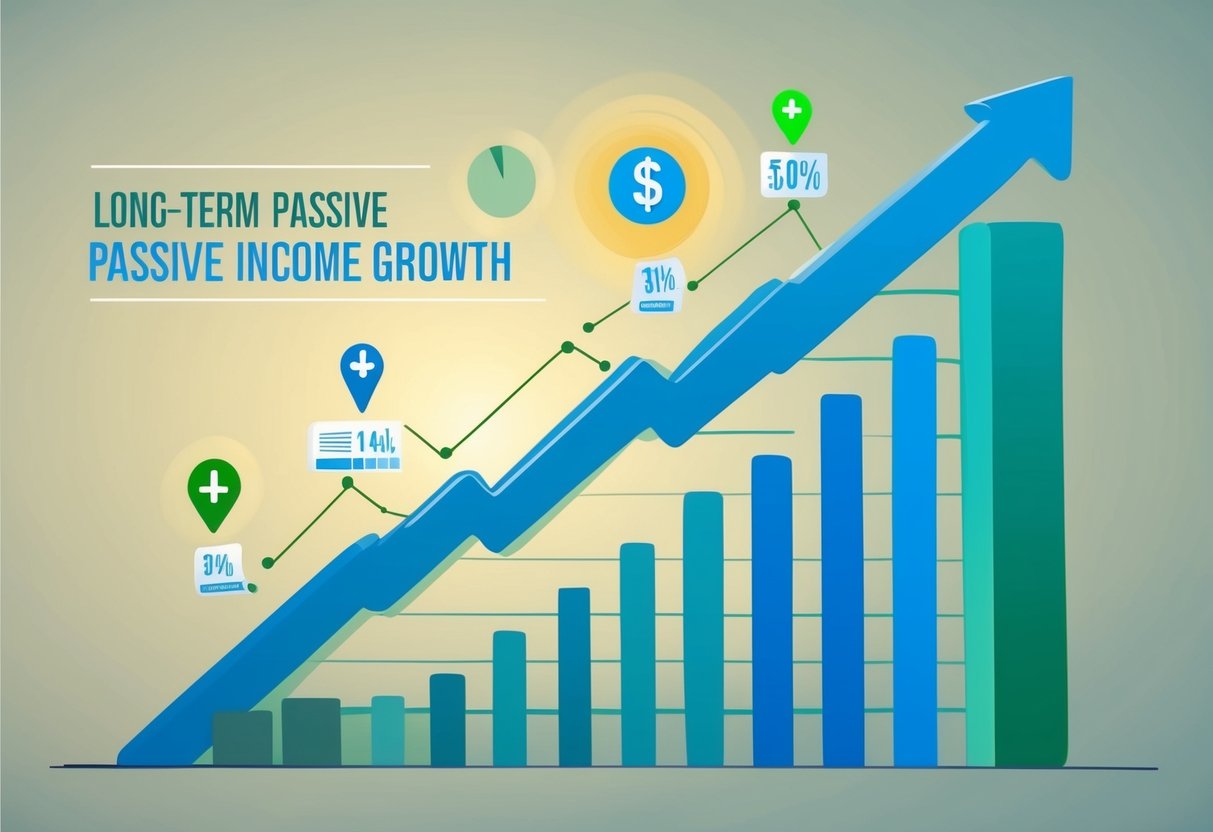
Focusing on key performance indicators (KPIs) is essential when scaling passive income streams.
The strategic use of KPIs helps to outline a long-term vision and serves as a guide through strategic planning and measurable goals. These metrics are not just numbers; they’re tools for refining decision-making.
Incorporating KPIs into Strategic Planning
What role do KPIs play in strategic planning? They serve as a compass.
KPIs indicate whether the strategy aligns with the long-term vision. By analyzing KPIs, I can see if my passive income efforts are heading in the right direction.
For instance, KPIs like revenue growth, customer acquisition cost, and cash flow help in assessing the effectiveness of strategies. They offer clear benchmarks.
This is critical for making informed decisions about where to allocate resources. When I carefully select KPIs, they guide my tactic adjustments, ensuring each step supports larger goals.
Setting Measurable Goals for Sustained Growth
How do you set goals that truly support sustained growth?
It’s about defining success in clear, measurable terms. KPIs make goals tangible. Instead of hoping for more income, I look at specific metrics like the return on investment (ROI) of my income streams.
Setting goals like improving ROI or increasing monthly cash flow requires tracking relevant KPIs.
By monitoring trends and analyzing data, I can pinpoint areas needing adjustment. These measurable targets help retain focus. They also allow me to evaluate progress objectively, avoiding the false comfort of guesswork.
Reflecting on the Bigger Picture
Are my KPIs reflecting a meaningful bigger picture?
In scaling passive income, stepping back to see the overall scenario ensures that the micro-goals feed into the larger vision. Aligning KPIs with my long-term aspirations safeguards against short-sighted decisions.
For example, while a spike in sales is good, does it reflect sustainable growth? KPIs encourage a wider perspective. They help me stay connected to my original objectives, like financial independence or supporting my family’s future.
This comprehensive reflection steers me clear of the dreaded financial trap of just chasing numbers.
Optimizing Financial Management Through KPIs

Managing financial metrics effectively can greatly impact the scalability of passive income. By focusing on crucial areas like handling cash flow through accounts receivable and payable, determining cost per unit and cost of goods sold, and analyzing financial ratios, we can make informed decisions to enhance our financial strategies.
Managing Accounts Receivable and Payable
Accounts receivable and payable form the backbone of cash flow management.
Are you keeping track of how long it takes to collect payments from customers? A solid strategy can prevent cash shortages and improve liquidity.
Consider implementing a system to monitor these accounts closely. Timely invoicing and polite follow-ups are simple yet effective practices.
On the payable side, stretching out your liabilities without harming supplier relationships is key. Prioritize liabilities, and negotiate better terms where possible.
Efficient management helps maintain healthier current ratios, which measure liquidity and ability to cover short-term debts. These tactics collectively ensure smoother operation and reduce financial stress.
Calculating Cost Per Unit and COGS
Understanding cost per unit and cost of goods sold (COGS) is critical for pricing and profitability.
How much does every product cost you to make, and how does that impact your bottom line? Accurately calculating COGS helps in determining profit margins, guiding pricing strategies effectively.
Break down all direct costs such as materials and labor. The lower the COGS, the higher the potential profit.
By controlling costs without compromising quality, we can enhance our competitive position in the market. Regularly reviewing these metrics allows me to adjust operations swiftly and stay ahead of financial pitfalls.
Understanding Financial Ratios
Financial ratios provide insights into a company’s performance and health.
Key ratios, like the current ratio, offer a snapshot of the organization’s ability to meet short-term obligations.
Is your company maintaining a strong liquidity position to deal with unexpected expenses?
A well-maintained current ratio signals strength to investors and creditors.
Analyzing sales data along with other ratios, like debt-to-equity, reveals operational efficiency and leverage.
These metrics can act as compass points, pointing to areas needing attention.
By regularly reviewing these ratios, I ensure that my financial strategies are aligned with my goals, helping me navigate the complexities of building sustainable passive income sources.