Dreaming of early retirement? You’re not alone. Many people think they need a fortune to quit the rat race, but that’s not always true. A modest $1,000 investment could be your ticket to financial freedom.  Starting with just $1,000 can set you on the path to early retirement if you invest wisely and consistently. By putting your money to work in retirement accounts like a 401(k) or IRA, you can take advantage of compound interest and potentially double your investment over time. The key is to start early and be patient. But where should you invest that $1,000? I recommend creating a diversified portfolio that balances risk and reward. This might include a mix of stocks, bonds, and other assets. Remember, the goal isn’t to get rich quick, but to build wealth steadily over time. Are you ready to take the first step towards your early retirement dreams?
Key Takeaways
- A small initial investment can grow significantly with compound interest and consistent contributions
- Diversifying your portfolio helps balance risk and potential returns
- Starting early and staying committed to your investment strategy is crucial for achieving financial independence
Understanding the Concept of Early Retirement
Early retirement isn't just about quitting your job sooner. It's about taking control of your financial future and having the freedom to live life on your terms. Let's explore what this really means and how you can make it happen.Defining Early Retirement and Financial Independence
Early retirement means leaving the workforce before the traditional retirement age of 65. But it’s more than that. It’s about achieving financial independence, where your investments generate enough income to cover your expenses without needing a paycheck. I believe true financial independence gives you options. Want to travel the world? Start a business? Volunteer full-time? When you’re financially independent, you can do what you love without worrying about money. The key is to build passive income streams. These could be from rental properties, dividend-paying stocks, or online businesses. The goal? To have your money work for you, not the other way around.
The Basic Principles of Retiring Early
Retiring early boils down to a simple formula: spend less than you earn and invest the difference. But it takes discipline and smart planning to make it work. Here are the core principles I’ve found crucial for early retirement:
- Live below your means
- Maximize your savings rate
- Invest wisely for growth and income
- Create multiple income streams
- Minimize debt
The math is shockingly simple. The more you save and invest, the faster you can retire. For example, if you save 50% of your income, you could potentially retire in just 17 years. But what about healthcare? What about inflation? These are valid concerns. That’s why it’s crucial to build a robust financial plan that accounts for these factors.
Getting Started with Investment
Starting your investment journey with $1,000 can be a game-changer. It's not about how much you start with, but how you use it. Let's explore the key steps to kick off your investment path.The Role of $1,000 in Starting Your Investment Journey
Can $1,000 really make a difference? Absolutely. I’ve seen people transform their financial futures with just this amount. It’s all about mindset and strategy. $1,000 is your seed money. It’s enough to get you into the game and start learning. With this amount, you can:
- Open a brokerage account
- Buy fractional shares of high-quality stocks
- Invest in low-cost index funds
- Start a retirement account like a Roth IRA
Remember, the goal isn’t just to invest $1,000 and stop. It’s to build the habit of investing regularly. Start small, learn, and grow.
Choosing the Right Investment Vehicles
What should you invest in? That’s the million-dollar question. Here are some options to consider:
- Index funds: Low-cost, diversified exposure to the market
- Individual stocks: Higher risk, but potential for higher rewards
- Real estate investment trusts (REITs): A way to invest in property without buying it
- Bonds: Generally lower risk, steady income
Your choice depends on your goals and risk tolerance. Don’t put all your eggs in one basket. Diversification is key.
Understanding Risk Tolerance and Investment Strategy
What’s your stomach for risk? Can you sleep at night if your investments drop 20%? Your risk tolerance shapes your investment strategy. High-yield savings accounts are safe but offer low returns. Stocks can be volatile but historically provide higher returns. Your investment portfolio should reflect your risk tolerance. Consider your time horizon too. Are you investing for retirement in 30 years or a down payment in 5? Longer time horizons usually allow for more risk. Remember, investing isn’t a one-size-fits-all game. It’s about finding what works for you and sticking to it.
Maximizing Retirement Savings Accounts
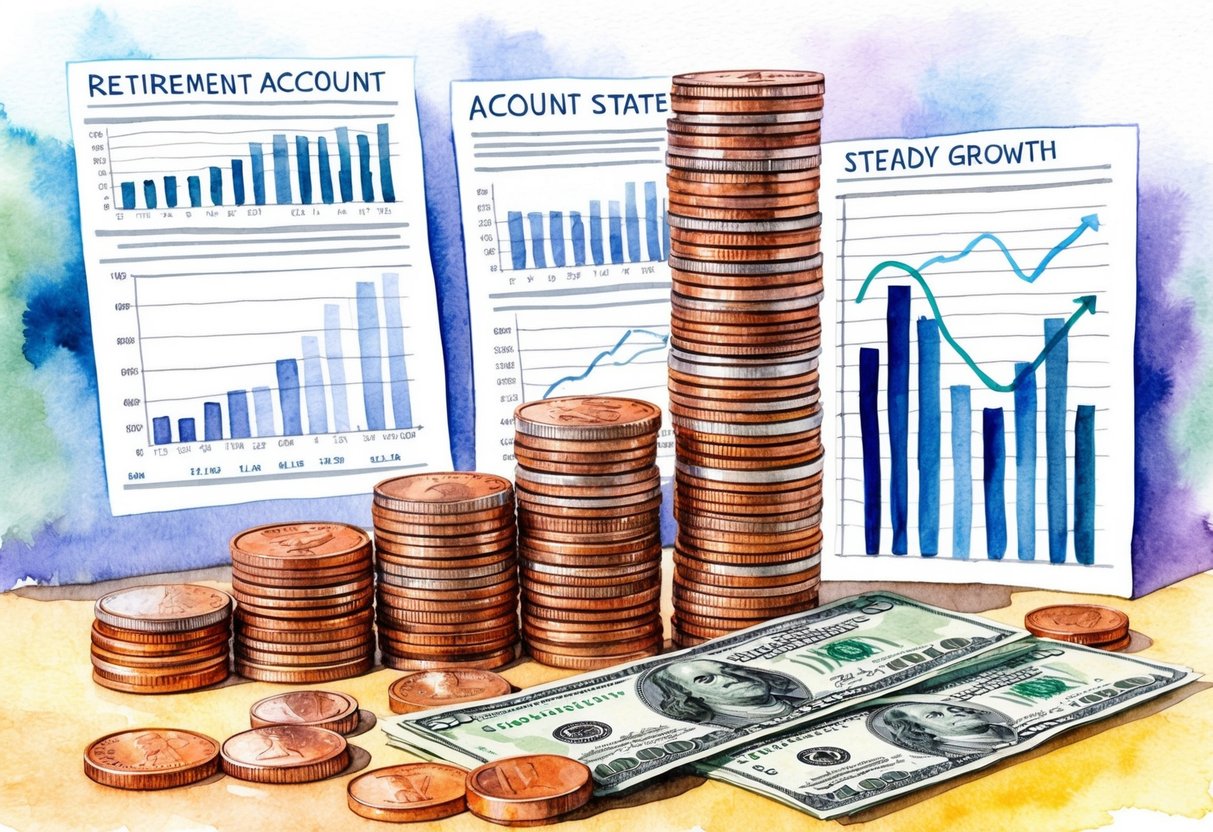 Retirement accounts offer powerful ways to grow your nest egg. Let’s explore how to make the most of these tax-advantaged options and set yourself up for financial freedom.
Benefits of 401(k)s and IRAs
401(k)s and IRAs are my go-to tools for building wealth. Why? They offer tax benefits that can turbocharge your savings. With a 401(k), you can contribute pre-tax dollars, reducing your taxable income now. Many employers also match contributions - that’s free money! IRAs give you more control over your investments. You can choose from a wide range of options to suit your risk tolerance and goals. Both accounts allow your money to grow tax-deferred. This means you won’t pay taxes on the gains until you withdraw funds in retirement. Are you taking full advantage of these accounts? If not, you’re leaving money on the table.
Roth IRAs vs. Traditional IRAs
Choosing between Roth and Traditional IRAs can be tricky. Let’s break it down. Traditional IRAs offer tax deductions now, but you’ll pay taxes when you withdraw. Roth IRAs flip this - you pay taxes on contributions, but withdrawals in retirement are tax-free. Which is better? It depends on your situation. If you expect to be in a higher tax bracket in retirement, a Roth IRA might be the way to go. If you need the tax break now, a Traditional IRA could be your best bet. Remember, you can have both types of accounts. This gives you flexibility in managing your tax burden in retirement. Have you considered how your tax situation might change in the future?
Navigating Tax-Advantaged Retirement Accounts
Tax-advantaged accounts can seem complex, but they’re powerful wealth-building tools. Here’s how to make the most of them:
- Max out your contributions if possible
- Take advantage of catch-up contributions if you’re over 50
- Diversify your investments within these accounts
- Rebalance regularly to maintain your desired asset allocation
Don’t forget about less common options like SEP IRAs or Solo 401(k)s if you’re self-employed. These can allow for even higher contribution limits. Are you using all the tax-advantaged options available to you? If not, you might be missing out on significant savings potential.
Creating a Diversified Investment Portfolio
 A smart investment strategy spreads your money across different assets. This helps protect you from big losses and gives you a better shot at steady growth. Let’s look at why diversification matters and some ways to build a balanced portfolio.
The Importance of Diversification in Investments
Why put all your eggs in one basket? That’s the key question when it comes to investing. I’ve seen too many people lose big by betting everything on one stock or industry. Diversification is your safety net. By spreading your money around, you’re less likely to get wiped out if one investment tanks. It’s like having insurance for your money. When one part of your portfolio dips, another might rise to balance it out. But how do you actually diversify? It’s simpler than you might think. You can invest in different:
- Industries (tech, healthcare, energy)
- Company sizes (large, medium, small)
- Geographic regions (U.S., international, emerging markets)
- Asset types (stocks, bonds, real estate)
Mutual Funds, Index Funds, and ETFs as Investment Options
Don’t want to pick individual stocks? No problem. Mutual funds, index funds, and ETFs can do the heavy lifting for you. These are like baskets of investments bundled together. Mutual funds are actively managed by pros. They try to beat the market, but often come with higher fees. Index funds, on the other hand, simply track a market index like the S&P 500. They’re usually cheaper and can perform just as well or better over time. ETFs are like index funds that trade like stocks. They offer flexibility and can be a great way to diversify. Many ETFs focus on specific sectors or themes, letting you tailor your portfolio.
Asset Allocation Strategies
How much should you put in stocks versus bonds? That’s where asset allocation comes in. It’s about finding the right mix for your goals and risk tolerance. A classic strategy is the 60/40 split: 60% stocks for growth, 40% bonds for stability. But there’s no one-size-fits-all approach. As you get closer to retirement, you might want to shift more into bonds to protect your nest egg. Here’s a simple guide:
- Aggressive: 80-90% stocks, 10-20% bonds
- Moderate: 60-70% stocks, 30-40% bonds
- Conservative: 30-40% stocks, 60-70% bonds
Remember, your ideal mix may change over time. It’s smart to review and rebalance your portfolio regularly. This keeps your investments aligned with your goals as life changes.
Income Strategies to Fund an Early Retirement
 Planning for early retirement requires smart income strategies. Let’s explore some effective approaches to make your money work for you and secure a comfortable future.
Utilizing the $1,000 per Month Rule
Have you ever wondered how much you really need to retire? The $1,000 per month rule is a simple but powerful concept. For every $1,000 in monthly income you want in retirement, aim to save $240,000. This rule helps you set clear savings goals. Here’s how it works:
- Want $3,000 per month? Save $720,000
- Need $5,000 per month? Aim for $1,200,000
I’ve found this rule to be a great starting point for many of my clients. It’s not perfect, but it gives you a target to shoot for. Remember, inflation can eat away at your savings, so I always advise adding a buffer.
Passive Income Streams and Withdrawal Strategies
What if I told you there’s a way to make money while you sleep? That’s the power of passive income. Rental properties, dividend stocks, and online businesses can provide steady cash
Planning for Healthcare in Retirement
 Healthcare costs can be a big worry for retirees. I’ve seen many people struggle with this, but there are ways to prepare. Let’s look at how Medicare fits in and why we need to think about long-term care too.
Medicare and Its Role in Retirement Planning
Medicare is a key part of retirement health planning, but it’s not a cure-all. It starts at age 65 for most people. But did you know it doesn’t cover everything? Here’s what Medicare typically covers:
- Hospital stays
- Doctor visits
- Prescription drugs (with Part D)
But there are gaps. You might need to pay for:
- Deductibles
- Copayments
- Premiums
I always tell my clients to budget for these extra costs. Health care expenses in retirement can add up to $315,000 for a couple over 20 years. That’s a lot of cash!
Long-Term Care and Unexpected Medical Expenses
What about long-term care? It’s a wild card that can bust your retirement budget. Have you thought about how you’d pay for a nursing home? The numbers are eye-opening. A private nursing home room can cost $108,405 per year. That’s $9,000 a month! And Medicare won’t cover most of it. So what can you do? Here are some options:
- Long-term care insurance
- Health Savings Accounts (HSAs)
- Setting aside extra savings
I’m a big fan of HSAs. They offer triple tax advantages and can be a powerful tool for healthcare costs in retirement.
Navigating Market Volatility and Sequence of Returns
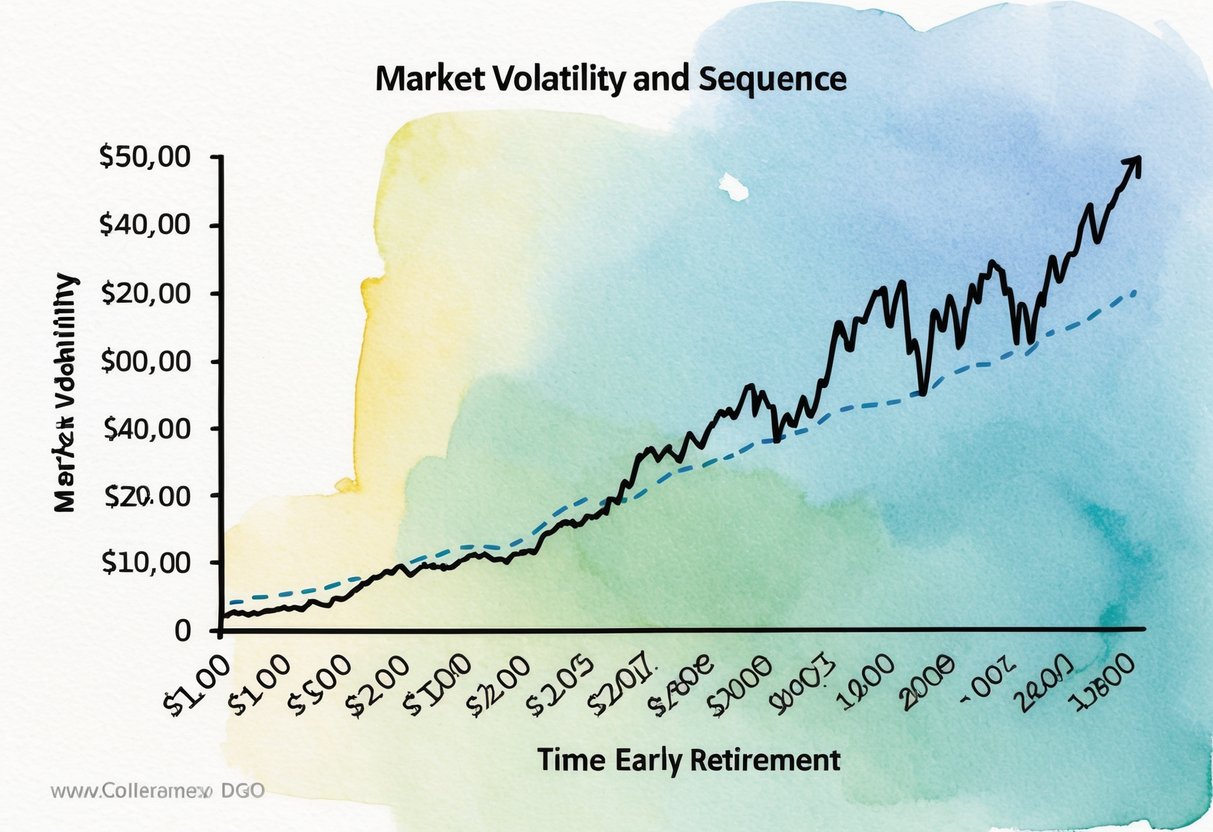 Market ups and downs can make or break your early retirement plans. Let’s explore how these factors impact your nest egg and what you can do to protect it.
The Impact of Market Conditions on Early Retirement
Have you ever wondered why some retirees thrive while others struggle? It’s often due to sequence of returns. This refers to the order in which you experience investment returns, especially in the early years of retirement. If the market tanks right after you retire, you’re in trouble. Why? You’re withdrawing money from a shrinking pot. On the flip side, if you retire during a bull market, you’re golden. Your portfolio grows even as you take money out. But here’s the kicker: you can’t control market timing. So what can you do?
Strategies to Mitigate Sequence of Returns Risk
I’ve seen too many people caught off guard by market swings. Don’t let that be you. Here are some strategies I recommend:
- Build a cash buffer: Keep 2-3 years of expenses in cash or low-risk investments.
- Use a bucket strategy: Divide your portfolio into short-term, medium-term, and long-term buckets.
- Be flexible with withdrawals: Cut back during market downturns to preserve capital.
Remember, staying invested for the long haul is key. Don’t panic sell when markets dip. Instead, view it as a buying opportunity.
Utilizing Financial Advisors and Retirement Planning Services
 When it comes to growing your $1,000 investment into a retirement nest egg, expert guidance can make a world of difference. Let’s explore how financial advisors can help you maximize your money and plan for a secure future.
The Value of Professional Financial Advice
Have you ever wondered if your money could work harder for you? That’s where a financial advisor comes in. These pros can offer insights I’ve seen transform people’s financial lives. They’ll help you:
- Create a customized investment strategy
- Optimize your asset allocation
- Minimize taxes on your investments
- Navigate complex financial products
I’ve found that advisors often pay for themselves by helping you avoid costly mistakes. They can spot opportunities you might miss and provide a steady hand during market turbulence. Remember, it’s not just about growing your money—it’s about protecting it too.
When and How to Consult with a Financial Advisor
You might be thinking, “When’s the right time to bring in a pro?” I’d say it’s never too early, but there are key moments when expert advice is crucial:
- When you’re 5-10 years from retirement
- After a major life change (marriage, kids, job switch)
- If you inherit money or receive a large windfall
To find the right advisor, start by asking for referrals from friends or colleagues. Look for credentials like CFP (Certified Financial Planner) and check their fee structure. Some work on commission, others charge a flat fee or a percentage of assets managed. I recommend interviewing at least three advisors before deciding. Ask about their investment philosophy and how they’ve helped clients in similar situations to yours. Trust your gut—you want someone you’re comfortable with for the long haul.
Social Security and Retirement Planning
 Social Security can play a crucial role in your early retirement strategy. Let’s explore how to make the most of these benefits and integrate them into your overall plan.
Integrating Social Security Benefits into Your Retirement Plan
Have you considered how Social Security fits into your retirement puzzle? It’s not just a bonus - it’s a key piece. I’ve seen many people overlook this valuable resource. Social Security can provide a steady income stream in retirement. For every $240,000 you save, you could potentially receive $1,000 a month in retirement income. This can significantly boost your retirement savings. But remember, Social Security isn’t meant to be your sole income source. It’s designed to replace about 40% of your pre-retirement earnings. That’s why it’s crucial to have other investments and savings.
Optimizing Social Security Withdrawals for Early Retirement
Timing is everything when it comes to Social Security. Did you know that claiming benefits early can reduce your monthly payment? It’s true, and it’s a decision that requires careful consideration. If you claim at 62, your benefit could be reduced by up to 30%. But waiting until your full retirement age (66-67 for most people) means you’ll receive 100% of your benefit. For those aiming for early retirement, there’s a strategy worth considering. You could use your savings to bridge the gap between early retirement and your full retirement age. This allows your Social Security benefit to grow, potentially increasing your long-term income. Remember, Social Security decisions are personal. What works for your neighbor might not work for you. Always consider your unique financial situation and retirement goals.
Adapting to Changes and Reassessing Goals
 Life is full of surprises, and our financial journey is no exception. We need to be ready to adjust our plans and learn from common mistakes.
Adjusting Your Plan Based on Life Changes
Have you ever had a major life event shake up your finances? I know I have. Whether it’s a new job, a growing family, or a health issue, these changes can impact our financial goals. Here’s what I do when life throws a curveball:
- Reassess my budget
- Adjust my savings rate
- Review my investment strategy
For example, if I get a pay raise, I might increase my 401(k) contributions. On the flip side, if I face unexpected expenses, I might need to temporarily reduce my savings. It’s crucial to stay flexible. Remember, a $1,000 investment today could grow significantly over time, even if you need to pause contributions later.
Avoiding Common Retirement Mistakes
I’ve seen many people make avoidable mistakes on their path to retirement. Are you making any of these?
- Not starting early enough
- Underestimating expenses
- Ignoring inflation
- Failing to diversify investments
One big mistake is not maximizing retirement account contributions. In 2024, you can contribute up to $23,000 to a 401(k), plus an extra $7,500 if you’re 50 or older. Another error? Neglecting to account for healthcare costs. I always remind people to factor in potential medical expenses when planning for retirement. By avoiding these pitfalls and staying adaptable, you’ll be better positioned to reach your early retirement goals.
Embracing the FIRE Movement
 The FIRE movement has sparked a revolution in how people think about money and retirement. It’s not just about saving pennies - it’s about reimagining your entire financial future.
Basics of the Financial Independence, Retire Early (FIRE) Philosophy
FIRE isn’t just a catchy acronym - it’s a powerful mindset shift. The core idea? Save aggressively now to buy your freedom later. Most FIRE followers aim to save 50-70% of their income. Sounds crazy, right? But here’s the kicker: by living well below your means, you can build a nest egg that supports you decades earlier than traditional retirement age. How do they do it? It’s all about maximizing income and slashing expenses. FIRE enthusiasts often pursue side hustles, negotiate raises, and seek out high-paying careers. On the flip side, they ruthlessly cut costs - think tiny homes, minimal possessions, and frugal living. The magic number? Most FIRE adherents aim for a nest egg of 25 times their annual expenses. This allows for a 4% yearly withdrawal rate, which historically has provided a sustainable income stream.
Case Studies of Successful FIRE Strategies
Let me share a few real-world FIRE success stories. Take John, a software engineer who retired at 38 with $2 million saved. His secret? Living on just 30% of his six-figure income for a decade. Or Sarah, a teacher who reached financial independence by 45 through smart real estate investments and a minimalist lifestyle. What about average earners? Meet Tom and Lisa, a middle-class couple who retired in their early 50s by maxing out their 401(k)s, eliminating debt, and downsizing to a smaller home. They proved that FIRE isn’t just for high-income tech workers. The key takeaway? FIRE isn’t one-size-fits-all. It’s about finding your own path to financial freedom. Whether you go all-in or just adopt a few principles, the FIRE movement can revolutionize your financial future.
Investment Tools and Resources
 Smart investors know that having the right tools and knowledge can make all the difference. I’ve found that utilizing calculators, apps, and educational resources can supercharge your investing journey.
Utilizing Investment Calculators and Apps
Have you ever wondered how much your money could grow over time? Investment calculators are a game-changer. I love using them to see the potential of my investments. Many high-yield savings accounts offer built-in calculators to show your earnings over time. But why stop there? Investment apps have revolutionized how we manage money. They put the power of Wall Street in your pocket. Some popular options include:
- Robinhood: Commission-free trading
- Acorns: Rounds up purchases and invests the difference
- Betterment: Automated investing based on your goals
These tools make it easy to start small and grow your wealth over time. Remember, consistency is key. Even small investments of $1,000 can snowball into significant sums.
Educational Resources for Self-Directed Investors
Knowledge is power, especially in investing. But where should you start? I’ve found some excellent resources for self-directed investors:
- Online courses: Platforms like Coursera and Udemy offer in-depth investing courses.
- Financial news sites: Stay updated with CNBC, Bloomberg, or The Wall Street Journal.
- Investment books: “Rich Dad Poor Dad” and “The Intelligent Investor” are classics.
- Podcasts: “Listen Money Matters” and “Motley Fool Money” offer bite-sized financial wisdom.
Don’t forget about target-date funds. They’re a great way to set it and forget it, adjusting risk as you approach retirement. By educating yourself, you’re taking control of your financial future. Isn’t that what financial independence is all about?