
Feeling like you’re stuck on a financial treadmill, working hard but not quite getting ahead? You’re not alone. Many people, especially those over 40, are starting to question traditional financial advice. It’s time to explore how tax strategies can accelerate your journey to financial freedom by scaling your passive income. The secret is using tax planning to maximize your passive income benefits, leading to more wealth and less stress.  Passive income, from sources like rental properties or dividends, has the potential to revolutionize your financial future. But if you’re not smart about how you handle taxes, you might end up giving away more than necessary. Leveraging legal tax reduction techniques can make a significant impact on how much wealth you really keep. Imagine if you could lower your tax burden and let your investments grow with minimal interference. What if you could access strategies used by the wealthiest individuals to cut down taxes and boost returns? Investing with tax efficiency isn’t just for the elite. By structuring your investments wisely and working with knowledgeable tax professionals, you can achieve long-term financial goals that seemed out of reach. Let’s dive into the methods that can turn your passive income dreams into a reality.
Key Takeaways
- Use tax strategies to boost passive income.
- Tax planning can reduce the tax burden significantly.
- Working with experts helps achieve long-term goals.
Understanding Passive Income and Its Potential
 In an age where financial stability can seem elusive, understanding and leveraging passive income is crucial. Many people are looking beyond traditional salary-based income to discover additional pathways to financial freedom.
Forms of Passive Income
There are numerous forms of passive income, each with its potential benefits. Real estate is a popular choice, as it can generate rental income from properties. This income can be steady, but managing properties requires some effort. Another common form is dividend income, earned by investing in stocks that pay dividends. I often hear about interest from high-yield savings accounts or bonds, which provide a reliable, albeit smaller, income stream. Then there’s royalty income from intellectual properties like books, music, or patents. Digital products, such as selling rights to online courses, also contribute to passive income. Each of these streams requires an initial investment of either time or money, but they can prove valuable in the long run.
Comparing Passive and Active Income
Passive income is fundamentally different from active income, where you’re directly paid for your work, like a salary. With active income, effort and time equal your paycheck. In contrast, passive income allows money to work for you, creating a sense of financial autonomy. Rental properties, for example, pay you while you focus on other pursuits. The challenge is understanding how much initial effort each form of passive income demands. Consider the difference between working at a job and holding shares for dividends. One requires daily commitment, while the other works in the background, boosting financial security without constant attention. This distinction can redefine traditional views on wealth building, offering flexibility and freedom many people strive for.
The Tax Treatment of Passive Income
 When dealing with passive income, understanding tax implications is key. This includes recognizing how different income types are taxed and how passive activity rules might affect your returns.
Tax Implications of Different Income Types
Did you know that not all passive income is taxed the same way? This can influence your tax liability significantly. For instance, rental income, interest, and dividends are treated differently. Qualified dividends may be taxed at a lower long-term capital gains rate, but non-qualified dividends are often hit with higher ordinary income tax rates. With rentals, I can leverage depreciation and other deductions to lower taxes. However, if I sell a property, I might face capital gains taxes on any profit. Different rates apply based on whether these gains are short-term or long-term. It’s crucial to know these details to optimize any investment strategy.
Understanding Passive Activity Rules
Has anyone ever told you that not all losses can be written off immediately? In the world of passive income, passive losses are often limited by strict IRS passive activity rules. These rules decide whether I can use losses to offset ordinary income, which might limit deductions if I’m not actively involved in the business. For someone like me, Participating materially in a rental or business affects whether the income is considered passive or active. Net investment income tax (NIIT) might also apply if my investment income exceeds certain thresholds. These are intricate details, but mastering them helps me make informed decisions that minimize taxes and maximize returns.
Maximizing Tax Efficiency with Strategic Planning
 In boosting passive income, strategic tax planning plays a pivotal role. From deciphering the importance of tax planning to leveraging tax-advantaged accounts, smart strategies can help you keep more of your hard-earned money. Let’s dive into some essential tactics.
The Importance of Tax Planning
Did you know that proper tax planning can significantly enhance your wealth-building efforts? Many overlook the impact taxes have on income, treating them as a mere afterthought. Yet, understanding tax benefits and deductions is crucial in scaling passive income. I focus on structuring my investments in ways that reduce taxable income. Effective tax strategies can help me reinvest savings back into income-generating assets. This allows my money to grow faster and more efficiently.
Leveraging Tax-Advantaged Accounts
Using tax-advantaged accounts like IRAs and 401(k)s is a key strategy in my financial toolkit. These accounts offer significant tax deductions and benefits that can boost my passive income. For instance, traditional IRAs provide tax-deferred growth, meaning I won’t pay taxes on earnings until withdrawal. Roth IRAs, on the other hand, offer tax-free withdrawals in retirement. By maximizing contributions to these accounts, I can reduce my taxable income today and enjoy tax-free or tax-deferred growth.
Employing Depreciation and Amortization
Are you aware of the power of depreciation and amortization in real estate and business investments? These tools allow me to offset taxable income, reducing my overall tax burden while keeping cash flowing. In real estate, depreciation lets me deduct a portion of the property’s value from my taxable income each year. This non-cash expense can significantly lower taxes owed. Similarly, amortization applies to intangible assets, allowing deductions over time. Both strategies are crucial in managing and scaling my passive income streams.
Legal Tax Reduction Techniques
 Navigating tax reduction methods is crucial for scaling passive income efficiently. Key strategies include leveraging credits and deductions, investing in real estate, and planning for retirement income.
Utilizing Tax Credits and Deductions
Tax credits and deductions can significantly decrease taxable income. For instance, the Earned Income Tax Credit can provide substantial savings to qualifying taxpayers. Credits directly reduce tax liability, making them more valuable than deductions, which lessen taxable income. Deductions are also powerful tools. A common strategy is to maximize deductions like business expenses or healthcare costs. By itemizing, one can often find additional savings. For those with rental properties, claiming deductions for property-related costs can substantially lower tax liabilities. By understanding and utilizing these options, I’ll find more room to grow my passive income streams.
Real Estate Investment Strategies
Real estate offers unique tax advantages. One such strategy is the use of 1031 exchanges, which allow property reinvestment without immediate tax penalties. This can be a game changer for keeping investments working for me. Investing in rental properties provides opportunities to deduct expenses related to property management, maintenance, and repairs. This shrinks taxable income from real estate investments, boosting overall returns. The Qualified Business Income Deduction also benefits rental real estate owners, reducing taxable income by up to 20% if eligibility criteria are met.
Retirement Planning and Income
Planning for retirement is not just about saving. It’s about strategically using tax-advantaged accounts. By contributing to a tax-deferred retirement plan like a 401(k), I can reduce taxable income now and grow savings tax-free. Learning the ins and outs of IRAs and Roth IRAs allows me to control when taxes are paid, providing flexibility according to my financial goals. Properly managing withdrawals in retirement can also minimize tax hits, allowing more capital to remain invested. These strategies show how thoughtful tax management isn’t just about saving money—it’s about making more money work for me in the long term.
Structuring Your Investments
 In this section, I focus on how to build a solid investment strategy. By choosing the right business structure and spreading investments across different asset classes, you can protect your wealth and maximize growth.
Choosing the Right Business Entity
When it comes to protecting your assets, selecting the right business entity is crucial. Have you considered forming an LLC? Setting up an LLC can offer significant protection by keeping your personal assets separate from your business liabilities. This structure helps shield your wealth from potential lawsuits or debts. Another option to explore is a limited partnership. By doing this, you can benefit from shared responsibility and varied levels of risk exposure. Limited partners enjoy the perk of liability protection while general partners manage the business operations. Both structures can help optimize tax strategies, such as reducing tax liability on passive income through business deductions. Choosing the right entity is key to aligning with your financial goals. Keep in mind that each option comes with unique benefits, so it’s essential to evaluate which best matches your investment strategy.
Diversification Across Asset Classes
Diversification is a strategy that reduces risk by allocating investments among various financial instruments. It can mean the difference between smooth sailing and a financial storm. I like to include dividend stocks and bonds in the mix because they provide both growth and income. Dividend stocks offer regular income through dividends, while bonds can be more stable, offering fixed returns. Capital gains from appreciating assets like real estate can also play a vital role. What if you could tap into increasing home values while earning rental income? It’s all about spreading your bets across different sectors. By diversifying your portfolio, you’re not putting all your eggs in one basket. This balance safeguards against market fluctuations, ensuring that if one asset class dips, the others can pick up the slack. Diversification is essential to achieving strong, consistent returns on investments.
Advanced Tax Strategies for Different Income Sources
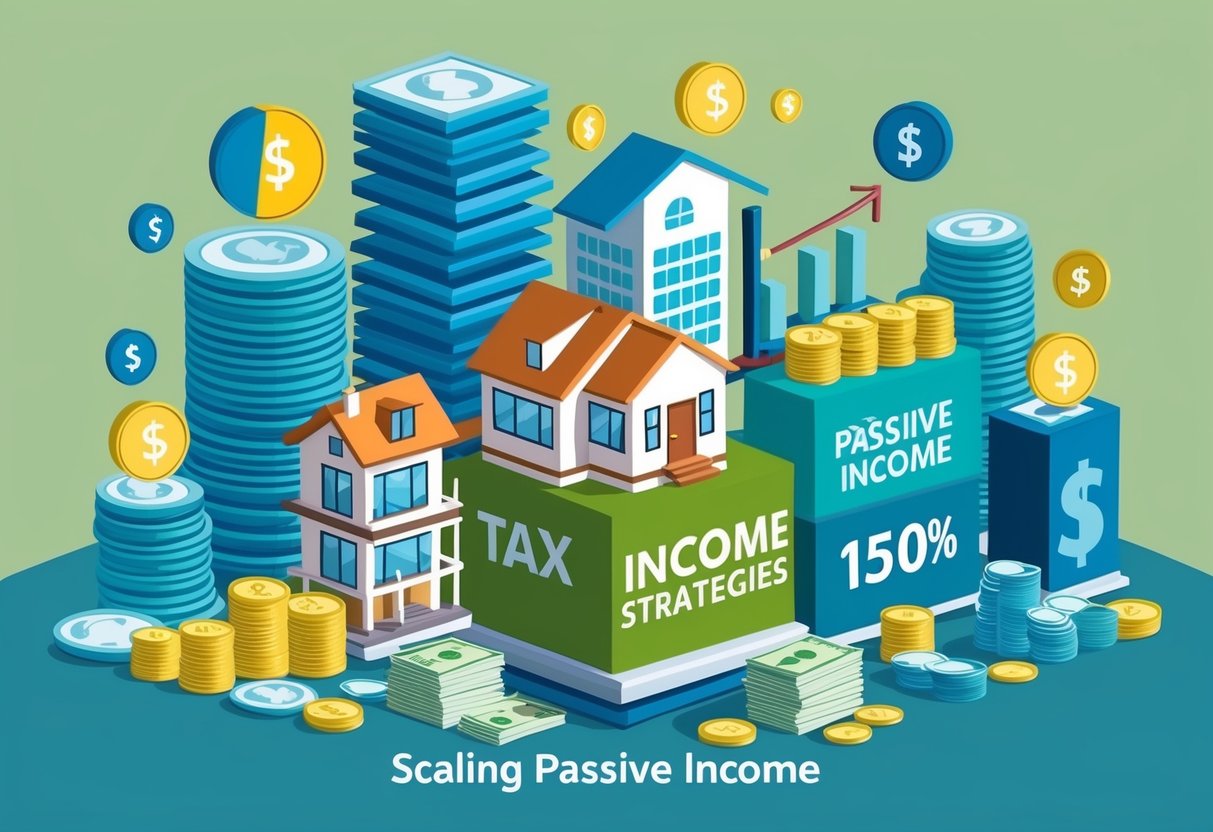 I’m going to dive into some key strategies to enhance your passive income while minimizing taxes. We’ll look at optimizing your portfolio and special considerations for specific investments.
Optimizing Portfolio for Tax Purposes
- Do you know you can adjust your investments to boost tax efficiency?
- It’s all about focusing on tax-advantaged accounts and using techniques like tax-loss harvesting.
- Why pay more than you have to?
- By strategic planning, you can offset capital gains while improving your overall return.
- Investing in municipal bonds can be beneficial since the interest is often tax-exempt.
- Another tactic is reallocating your diversified portfolio to balance between high-return and tax-efficient assets, like municipal bonds and private lending returns.
- This balance maximizes potential returns while keeping the taxman at bay.
Tax Considerations for Specific Investments
- Each investment type has unique tax implications.
- Did you know that municipal bonds can help earn tax-free interest?
- This is a great way to achieve solid returns without inflating your tax bill.
- Another option is focusing on private lending, which can fit well into your overall tax plan by giving opportunities for high investment returns.
- Manage your investments carefully by considering tax-efficient income streams.
- Review every potential return on investment and choose those that align best with your goals and tax situation.
- Why settle for traditional advice when smarter tax strategies can put more passive income in your pocket?
Working with Tax Professionals

- Navigating the world of taxes can be daunting, but knowing when to consult a tax professional and understanding the power of detailed record keeping can significantly ease this journey.
- Proper guidance helps manage complex tax rules, while careful documentation ensures you don’t miss out on potential savings.
When to Consult a Financial Advisor or Tax Professional
- When is the right time to bring in the experts?
- As soon as your passive income streams start to grow, involving a financial advisor or tax professional can be a game changer.
- They can help you interpret complex tax codes and apply strategies to potentially reduce tax liabilities.
- Have you thought about the passive activity loss rules?
- These rules can be tricky, but with the right help, you can find ways to work within them.
- Tax professionals assist in spotting deductions you might overlook, ensuring you keep more of your earnings.
- This tailored advice is essential for effective wealth management, offering a personalized approach to scaling your income.
The Role of Record Keeping in Taxation
- Good record keeping is the backbone of effective tax strategies.
- Why is it crucial?
- Detailed records ensure you report accurate figures and claim every deduction possible.
- Without proper documentation, you risk incorrect filings or even penalties.
- Implementing an organized system for managing your financial documents is essential.
- Whether you prefer digital tools or traditional methods, consistency is key.
- Maintaining accurate and timely records means fewer headaches during tax season and maximizes your chances of leveraging tax-saving opportunities.
- In collaboration with tax professionals, this practice enhances your financial strategy, helping you to make informed decisions and plan for the future.
Incorporating Passive Income in Long-Term Financial Planning
 How do I make passive income a part of my future plans? It’s all about strategy and focus. Integrating passive income can boost your financial security and build long-term wealth. One key factor is tax efficiency. By understanding tax laws, I can keep more of my earnings. For example, rental properties allow me to deduct mortgage interest and maintenance costs, reducing my taxable income. This strategy enhances my wealth over time. When setting my financial goals, I consider different passive income sources. Rental properties, dividends from stocks, and high-yield savings accounts each offer unique benefits. Diversifying these income streams helps protect me from economic shifts. Long-term financial planning involves creating a balance between active and passive income. Why rely only on a paycheck? By including passive sources, I set myself up for a secure future. This approach aligns with a comprehensive wealth management plan. Visualizing my financial journey, I like to use a simple table to track goals:
Passive Income Source
Annual Goal
Current Status
Rental Properties
$10,000
$5,000
Dividends
$5,000
$2,500
Online Businesses
$3,000
$1,000
These targets motivate me and guide my decisions, ensuring I stay on track. By incorporating passive income into my plans, I create opportunities for growth and resilience. Isn’t it time to rethink traditional approaches and embrace the potential of passive income?